

Tomato Farming in India: Complete Cultivation Guide, Cost of Cultivation, Yield, Profit, Fertilizer Schedule, Pest Management, and Harvesting
Introduction
Tomato is one of the most profitable vegetable crops grown in India. It is cultivated throughout the year in different agro-climatic regions and has strong demand from fresh markets, processing industries, restaurants, and retail chains. With proper crop management, farmers can achieve high yields and attractive profits from tomato cultivation.
This guide covers everything farmers need to know about tomato farming, including climate requirements, land preparation, varieties, planting, fertilizer management, irrigation, pest and disease control, harvesting, yield, and profit analysis.
Importance of Tomato Farming
Tomato is a rich source of vitamins A and C, antioxidants, and minerals. It is used in salads, curries, sauces, ketchup, soups, and processed products. Due to continuous demand throughout the year, tomato cultivation offers excellent income opportunities for small and medium-scale farmers.

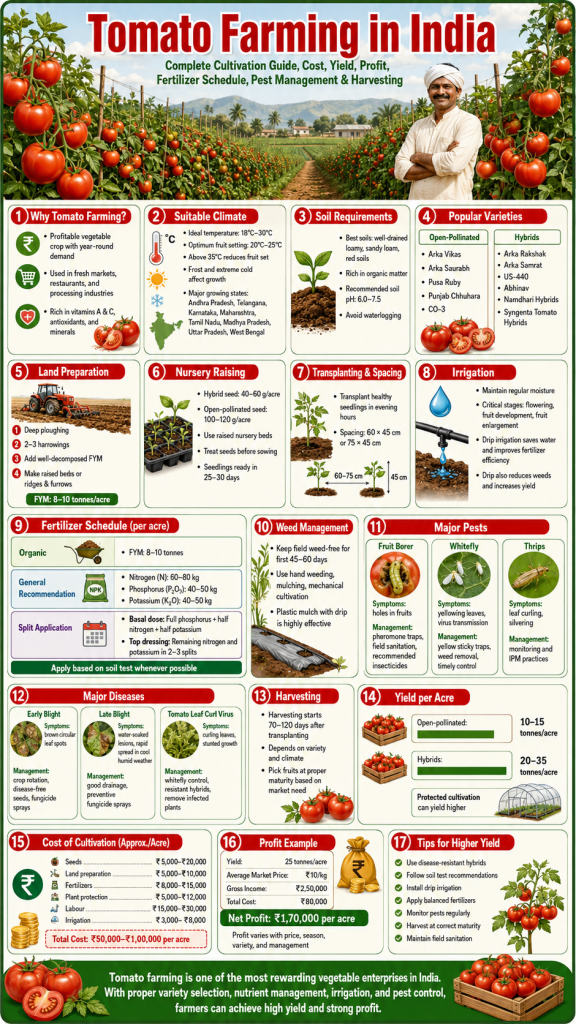
Suitable Climate for Tomato Cultivation
Tomato grows well under warm climatic conditions.
- Ideal temperature: 18°C to 30°C
- Optimum temperature for fruit setting: 20°C to 25°C
- Excessive heat above 35°C can reduce fruit set
- Frost and extremely cold conditions affect growth
Tomato can be cultivated in most states of India, including Andhra Pradesh, Telangana, Karnataka, Maharashtra, Tamil Nadu, Madhya Pradesh, Uttar Pradesh, and West Bengal.
Soil Requirements
Tomato grows best in:
- Well-drained loamy soil
- Sandy loam soil
- Red soils with good drainage
- Organic matter-rich soils
Recommended soil pH:
- 6.0 to 7.5
Avoid waterlogged fields as they increase disease incidence.
Popular Tomato Varieties in India
Open-Pollinated Varieties
- Arka Vikas
- Arka Saurabh
- Pusa Ruby
- Punjab Chhuhara
- CO-3
Hybrid Varieties
- Arka Rakshak
- Arka Samrat
- US-440
- Abhinav
- Namdhari Hybrids
- Syngenta Tomato Hybrids
Choose varieties based on local climate, market demand, and disease resistance.
Land Preparation
Prepare the field thoroughly:
- Deep ploughing
- Two to three harrowings
- Incorporate well-decomposed farmyard manure
- Create raised beds or ridges and furrows
Apply:
- 8–10 tonnes FYM per acre
Proper land preparation improves root growth and water management.
Nursery Raising
Seedlings are usually raised in nursery beds.
Seed Requirement
- Hybrid varieties: 40–60 grams per acre
- Open-pollinated varieties: 100–120 grams per acre
Nursery Management
- Use raised beds
- Treat seeds before sowing
- Provide regular irrigation
- Protect seedlings from pests and diseases
Seedlings become ready for transplanting within 25–30 days.
Transplanting
Healthy seedlings should be transplanted during the evening hours.
Recommended Spacing
- 60 cm × 45 cm
- 75 cm × 45 cm
Spacing depends on variety and cultivation method.
Irrigation Management
Tomato requires regular moisture throughout the crop cycle.
Critical Stages
- Flowering
- Fruit development
- Fruit enlargement
Drip irrigation is highly recommended because it:
- Saves water
- Improves fertilizer efficiency
- Reduces weed growth
- Increases yield
Fertilizer Schedule for Tomato
Organic Application
- FYM: 8–10 tonnes per acre
General Fertilizer Recommendation per Acre
- Nitrogen (N): 60–80 kg
- Phosphorus (P₂O₅): 40–50 kg
- Potassium (K₂O): 40–50 kg
Split Application
Basal Dose:
- Full phosphorus
- Half nitrogen
- Half potassium
Top Dressing:
- Remaining nitrogen and potassium in 2–3 splits
Apply fertilizers based on soil testing results whenever possible.
Weed Management
Keep fields weed-free during the first 45–60 days.
Methods:
- Hand weeding
- Mulching
- Mechanical cultivation
- Drip irrigation with plastic mulch
Mulching conserves moisture and suppresses weeds effectively.
Major Pests of Tomato
Fruit Borer
Symptoms:
- Holes in fruits
- Damaged fruits
Management:
- Pheromone traps
- Field sanitation
- Recommended insecticide applications
Whitefly
Symptoms:
- Yellowing leaves
- Virus transmission
Management:
- Yellow sticky traps
- Weed removal
- Timely control measures
Thrips
Symptoms:
- Leaf curling
- Silvering effect
Management:
- Monitoring
- Integrated pest management practices
Major Diseases of Tomato
Early Blight
Symptoms:
- Brown circular spots on leaves
Management:
- Crop rotation
- Disease-free seeds
- Timely fungicide sprays
Late Blight
Symptoms:
- Water-soaked lesions
- Rapid spread during cool, humid weather
Management:
- Good drainage
- Preventive fungicide sprays
Tomato Leaf Curl Virus
Symptoms:
- Curling leaves
- Stunted growth
Management:
- Whitefly control
- Resistant hybrids
- Removal of infected plants
Harvesting
Tomatoes are generally harvested:
- 70–120 days after transplanting
- Depending on variety and climate
Harvest fruits at the proper maturity stage according to market requirements.
Yield of Tomato Per Acre
Average yield:
- Open-pollinated varieties: 10–15 tonnes per acre
- Hybrid varieties: 20–35 tonnes per acre
Under protected cultivation, yields can be even higher.
Cost of Cultivation Per Acre
Approximate cost:
- Seeds: ₹5,000–₹20,000
- Land preparation: ₹5,000–₹10,000
- Fertilizers: ₹8,000–₹15,000
- Plant protection: ₹5,000–₹12,000
- Labour: ₹15,000–₹30,000
- Irrigation: ₹3,000–₹8,000
Total cost:
₹50,000–₹1,00,000 per acre
Tomato Farming Profit Per Acre
Example Calculation:
Yield:
25 tonnes per acre
Average Market Price:
₹10 per kg
Gross Income:
₹2,50,000
Total Cost:
₹80,000
Net Profit:
₹1,70,000 per acre
Profit may vary depending on market prices, season, variety, and production practices.
Tips for Higher Tomato Yield
- Use disease-resistant hybrids
- Follow soil testing recommendations
- Install drip irrigation
- Apply balanced fertilizers
- Monitor pests regularly
- Harvest at the correct maturity stage
- Maintain field sanitation
Conclusion
Tomato farming is one of the most rewarding vegetable cultivation enterprises in India. With proper variety selection, nutrient management, irrigation scheduling, and pest control practices, farmers can achieve high yields and attractive profits. A well-managed tomato crop can become a reliable source of income for both small and commercial growers.