

Table of Contents
- Why Farming Must Be Treated Like a Business
- Why Many Farmers Struggle to Earn Better Income
- Crop Selection Is the First Profit Decision
- Soil and Water Decide Farming Success
- Climate and Season Must Match the Crop
- Market Demand Can Change Profit
- Crop Duration Affects Cash Flow
- Organic Farming Can Help, But It Needs Planning
- Protected Cultivation Can Improve Results
- Risk Management Is Important
- Simple Profit Check Before Planting
- A Simple Step-by-Step Farming Plan
- Government Help and Farmer Support
- Practical Conclusion
Farming in India can become profitable when farmers plan carefully before planting.
The crop, soil, water, climate, market demand, labor, and cost all affect income.
This article explains practical farming lessons in simple language for Indian farmers.
Why Farming Must Be Treated Like a Business
Farming is not only about growing food. It is also about planning, investing, and selling wisely.
A farmer who thinks like a business owner usually makes better decisions.
This helps reduce losses and improves the chance of profit.
Many farmers work hard but still earn less than expected.
The reason is often poor planning, not lack of effort.
If the crop choice is wrong, even good labor and good land may not give the expected income.
Why Many Farmers Struggle to Earn Better Income
A major reason for low income is small landholding.
When land is limited, every decision matters more.
One wrong crop can reduce the income for the whole season.
Another issue is weak market access.
Many farmers sell to the nearest trader without comparing prices.
This often leads to lower profit.
High input costs also create pressure.
Seed, fertilizer, labor, irrigation, and pesticide costs add up quickly.
If farmers do not calculate these costs before planting, profit becomes uncertain.
Crop Selection Is the First Profit Decision
Choosing the right crop is one of the most important farming decisions.
A crop should suit the soil, water, climate, labor, and local market.
A crop that looks profitable on paper may fail if it does not fit the farm conditions.
For example, a water-heavy crop may fail in a dry area.
A crop that needs too much labor may not suit a family with limited workers.
A crop with low demand may not bring good returns even if the yield is high.
What to Check Before Selecting a Crop
Before planting, farmers should check a few basic things.
- Soil type.
- Water availability.
- Crop duration.
- Labor need.
- Market demand.
- Input cost.
These checks may look simple, but they can save money and reduce risk.
They also help farmers choose crops with better chances of success.

Soil and Water Decide Farming Success
Soil and water are the base of every crop.
If the soil is poor or water is limited, the crop may not grow well.
That is why farmers should understand both before planting.
Different crops grow better in different soils.
Some crops prefer loam, some prefer black soil, and some do well in sandy or red soil.
Knowing the soil type makes crop selection easier.
Water is equally important.
Some crops need regular watering, while others can survive with less.
Farmers in low-water areas should avoid crops that need heavy irrigation unless they have a reliable water source.
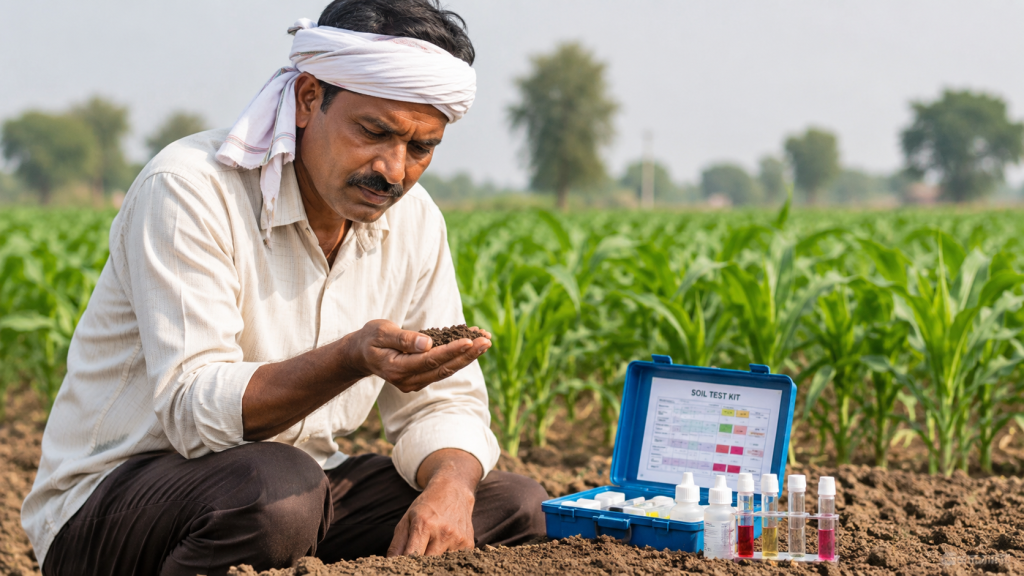
Why Soil Testing Matters
Soil testing gives useful information about nutrient levels and pH.
It shows what the soil needs before sowing.
This helps farmers avoid unnecessary spending on fertilizers.
A soil test also helps improve long-term productivity.
When the soil is balanced, crops grow better and give more stable yield.
This is why soil testing should be part of every crop plan.
Why Water Planning Matters
Water planning helps farmers avoid crop stress during dry periods.
If water is uncertain, choose crops that need less irrigation.
This reduces the chance of crop failure.
Drip irrigation and mulching can also help save water.
These methods reduce waste and improve water use efficiency.
For many small farms, this can make a big difference.
Climate and Season Must Match the Crop
Every crop has a season where it performs best.
Some crops suit the monsoon season, while others are better for winter or summer.
If the timing is wrong, yield can fall even if everything else is managed well.
Indian farmers should also watch rainfall, temperature, and local weather patterns.
A crop that works in one district may not work in another.
That is why local climate should always guide crop selection.
For example, a crop that cannot handle heat should not be planted in a very hot region.
A crop that dislikes excess rain should not be planted in a flood-prone area.
Matching the crop to the climate reduces risk and improves output.
Market Demand Can Change Profit
Even a high-yield crop may not bring good income if the market is weak.
That is why market demand matters as much as production.
Farmers should always ask who will buy the crop and at what price.
Before planting, check the local mandi price trend.
Also ask traders, commission agents, and nearby buyers about demand.
If possible, compare more than one market.
What Farmers Should Check in the Market
- Local buyer demand.
- Price trend.
- Transport cost.
- Storage need.
- Selling distance.
These points affect the final income from the crop.
A crop may look profitable in the field but may become less profitable after transport and commission charges.
Practical Market Example
Suppose a farmer grows a crop with good yield.
If the mandi price falls during harvest, profit may be low.
If the farmer sells at a better time or has a better buyer, income improves.
This is why market planning is part of farming.
Production alone is not enough.
Crop Duration Affects Cash Flow
Crop duration matters because farmers need money at different times.
Some crops give quick returns, while others take many months.
A farmer should choose based on financial need and season.
Short-duration crops are useful when cash is needed quickly.
They can help farmers recover money faster.
Long-duration crops may give better returns later, but they require more patience and investment.
If a farmer has limited savings, short-duration crops may be safer.
If the farm has enough support and a steady market, longer crops may also work well.
The right choice depends on the situation.
Organic Farming Can Help, But It Needs Planning
Organic farming is popular because many people want chemical-free produce.
It can improve soil health over time and reduce dependence on chemicals.
But it should not be treated as an instant profit method.
In the beginning, organic farming may give lower yield.
Pest control may also be harder.
Farmers may need time to build soil fertility and find the right market.
Challenges in Organic Farming
- Yield may be lower in the starting years.
- Pest control can be harder.
- Organic buyers may be limited in some areas.
Even so, organic farming can become profitable when managed well.
The key is proper planning, patience, and good marketing.
Protected Cultivation Can Improve Results
Protected cultivation means growing crops in a controlled setup.
This can include polyhouses, net houses, tunnels, or similar systems.
These setups protect crops from weather and pests.
Protected cultivation is useful for high-value crops.
It can improve quality and help farmers get better market prices.
It also gives more control over the growing environment.
But this method needs investment.
It is not suitable for every farmer or every crop.
Farmers should study the cost, market, and maintenance before starting.
When Protected Farming Helps
- For high-value crops.
- For areas with weather risk.
- For farmers with strong market access.
If these conditions are present, protected farming can be a smart choice.
If not, open-field farming may be better.
Risk Management Is Important
A farmer should never depend fully on one crop.
If that crop fails, the whole season may fail.
That is why risk management is necessary.
Crop rotation and intercropping can reduce risk and improve soil health.
Trying a small trial plot before full planting is also a smart idea.
This helps farmers test new methods without risking the whole farm.
Crop insurance is another useful protection.
It may not solve every problem, but it can reduce financial pressure after losses.
Farmer groups and cooperatives may also help with inputs and marketing.
Simple Profit Check Before Planting
Before planting, farmers should do a simple profit estimate.
First, list all costs like seed, fertilizer, labor, irrigation, pesticide, transport, and mandi charges.
Then estimate the expected yield and likely selling price.
Easy Profit Formula
- Gross income = yield × price
- Net income = gross income − total cost
This simple formula helps farmers compare crops.
It also shows whether the crop is worth the investment.
Profit planning should happen before sowing, not after harvest.
Practical Example
If a crop gives good yield but also needs high spending, profit may become low.
Another crop may give lower yield but better net income because its cost is lower.
This is why profit should always be calculated from the full picture.
A Simple Step-by-Step Farming Plan
Farmers can follow a basic process before choosing a crop.
- Check the soil.
- Check water availability.
- Check climate and season.
- Check market demand.
- Compare cost and profit.
- Select the crop.
- Start small if testing something new.
- Review results after harvest.
This method is simple but powerful.
It helps farmers make decisions based on facts instead of guesswork.
That leads to better results over time.
Government Help and Farmer Support
Farmers should also use support from government and local institutions.
Crop insurance, seed subsidy, irrigation support, and training can reduce risk.
These services are especially useful for small and beginner farmers.
KVKs and local agriculture offices can guide farmers on soil, seed, and crop planning.
They also share local advice that is often more useful than general information.
Checking these sources before planting is always a good habit.
Practical Conclusion
Profitable farming starts with planning.
The best crop is not always the most famous crop.
It is the crop that fits the farm, season, market, and budget.
Small farmers should focus on low-risk and high-fit choices.
They should also test before expanding and calculate profit before planting.
When farmers make better decisions, farming becomes more stable and more profitable.
Disclaimer
Crop profit depends on location, season, market price, input cost, labor, and farming practices.
Results can change from village to village and season to season.
Always test on a small area and use local expert advice when possible.
Frequently Asked Questions
What is profitable farming in India?
Profitable farming means choosing crops and farming methods that give better net income after all costs.
How do I choose the right crop for my farm?
Check your soil, water, climate, labor, crop duration, and market demand before deciding.
Which crops are good for small farmers?
The best crop depends on location, but short-duration and low-cost crops often work well for small farms.
Is organic farming profitable?
It can be profitable, but it needs time, planning, and a good market.
How does protected cultivation help?
It protects crops from weather and pests and can improve quality and market value.
Why is market research important in farming?
Because a crop that sells well gives better income than a crop with low demand.