

Jeevamrut: The Ultimate Guide to Natural Bio-Fertilizer for Sustainable Farming
Table of Contents
- What is Jeevamrut?
- Why Jeevamrut is Important
- Benefits of Jeevamrut
- Ingredients Required
- Equipment Needed
- How to Prepare Jeevamrut
- Fermentation Process
- How Jeevamrut Works
- Application Methods
- Dosage Recommendations
- Crop-wise Usage
- Best Time to Apply
- Frequency of Application
- Advantages of Jeevamrut
- Jeevamrut vs Chemical Fertilizers
- Common Mistakes to Avoid
- Frequently Asked Questions
- Conclusion Jeevamrut: The Ultimate Guide to Natural Bio-Fertilizer for Sustainable Farming
Modern farming has become increasingly dependent on chemical fertilizers, leading to declining soil fertility, rising cultivation costs, and environmental concerns. Farmers across India are now adopting natural farming methods that improve soil health while reducing production expenses. One of the most effective solutions is Jeevamrut, a natural liquid bio-fertilizer that enriches soil with beneficial microorganisms and organic nutrients.
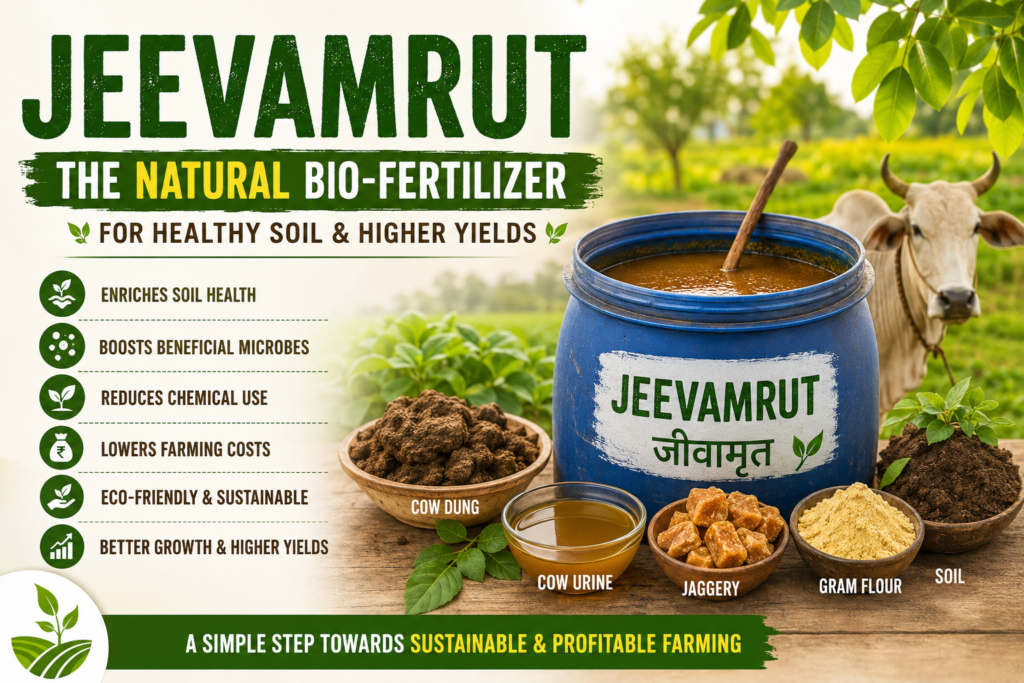
Prepared from cow dung, cow urine, jaggery, gram flour, soil, and water, Jeevamrut acts as a microbial culture rather than a conventional fertilizer. It stimulates biological activity in the soil, making nutrients readily available to crops and promoting sustainable agriculture.

What is Jeevamrut?
Jeevamrut is a fermented liquid bio-fertilizer widely used in natural and organic farming. The word “Jeevamrut” means “Nectar of Life,” reflecting its ability to restore soil fertility and promote healthy crop growth through beneficial microorganisms.
Instead of directly supplying nutrients to plants, Jeevamrut activates millions of beneficial microbes that naturally decompose organic matter and make nutrients easily available to crops.
Why Jeevamrut is Important
Healthy soil contains billions of microorganisms that play a vital role in plant nutrition. Excessive use of chemical fertilizers reduces microbial diversity and weakens soil fertility over time. Jeevamrut restores this biological balance by multiplying beneficial bacteria, fungi, and actinomycetes that naturally support plant growth.
It is an affordable, eco-friendly, and farmer-friendly solution that can be prepared using locally available ingredients.
Benefits of Jeevamrut
Improves Soil Health
Jeevamrut increases microbial activity, enhances soil structure, and improves long-term fertility.
Enhances Nutrient Availability
Beneficial microorganisms convert unavailable nutrients into forms that plants can easily absorb.
Promotes Root Development
Healthy microbial activity encourages stronger and deeper root systems.
Reduces Farming Costs
Farmers can prepare Jeevamrut using farm resources, reducing dependence on expensive chemical fertilizers.
Improves Water Retention
Organic matter and microbial activity improve soil moisture-holding capacity.
Increases Crop Growth
Regular application promotes healthy vegetative growth and improved crop vigor.
Eco-Friendly Farming
Jeevamrut supports sustainable agriculture by reducing chemical inputs and improving biodiversity.
Ingredients Required for Jeevamrut
| Ingredient | Quantity | Purpose |
|---|---|---|
| Fresh Cow Dung | 10 kg | Source of beneficial microorganisms |
| Cow Urine | 8–10 Liters | Provides nitrogen and microbes |
| Jaggery | 1–2 kg | Food for microorganisms |
| Gram Flour | 1–2 kg | Protein source for microbial growth |
| Soil from Under a Healthy Tree | 1 kg | Introduces native soil microbes |
| Water | 180–200 Liters | Medium for fermentation |
Equipment Needed
- 200-liter plastic drum
- Wooden stick for stirring
- Clean water
- Shade for fermentation
Avoid using metal containers.
How to Prepare Jeevamrut
Step 1
Fill a 200-liter plastic drum with approximately 180 liters of clean water.
Step 2
Add 10 kilograms of fresh cow dung.
Step 3
Pour 8 to 10 liters of cow urine into the drum.
Step 4
Add 1 to 2 kilograms of jaggery.
Step 5
Mix 1 to 2 kilograms of gram flour thoroughly.
Step 6
Add one kilogram of soil collected from beneath a healthy tree.
Step 7
Stir the mixture well using a wooden stick.
Step 8
Cover the drum with a breathable cloth and keep it in a shaded place.
Fermentation Process
Stir the solution twice daily, once in the morning and once in the evening.
Fermentation Time:
| Season | Time Required |
|---|---|
| Summer | 5–7 Days |
| Rainy Season | 6–10 Days |
| Winter | 8–15 Days |
Once fermentation is complete, Jeevamrut is ready for field application.
How Jeevamrut Works
Jeevamrut acts as a microbial inoculant that stimulates beneficial microorganisms already present in the soil. These microbes help decompose organic matter, fix atmospheric nitrogen, solubilize phosphorus, and improve nutrient availability, resulting in healthier plants and better soil fertility.
Application Methods
Soil Application
Apply directly through irrigation water or drench around the root zone.
Foliar Spray
Dilute Jeevamrut with water and spray evenly on plant leaves.
Drip Irrigation
Filter the solution before using it through drip irrigation systems.
Recommended Dosage
| Method | Recommended Dose |
|---|---|
| Soil Drench | 200 Liters per Acre |
| Foliar Spray | 10% Solution |
| Drip Irrigation | Filtered Solution |
Crop-wise Usage
Jeevamrut can be used successfully in:
Cereals
- Rice
- Wheat
- Maize
- Millets Pulses
- Black Gram
- Green Gram
- Pigeon Pea Oilseed Crops
- Groundnut
- Sesame
- Sunflower Vegetable Crops
- Tomato
- Chili
- Brinjal
- Okra
- Cabbage
- Cauliflower Fruit Crops
- Mango
- Banana
- Guava
- Citrus
- Papaya Plantation Crops
- Coconut
- Arecanut
- Coffee
- Tea
Best Time to Apply
- Early Morning
- Late Evening
- During Moist Soil Conditions
- Avoid Hot Afternoon Hours
Frequency of Application
Apply Jeevamrut every 15 days during the crop growth period for best results.
Advantages of Jeevamrut
- Improves soil fertility naturally
- Increases beneficial microorganisms
- Enhances nutrient availability
- Promotes healthy root growth
- Improves crop quality
- Reduces chemical fertilizer use
- Lowers cultivation costs
- Improves water retention
- Eco-friendly and sustainable
- Safe for humans, animals, and the environment
Jeevamrut vs Chemical Fertilizers
| Feature | Jeevamrut | Chemical Fertilizers |
|---|---|---|
| Soil Health | Improves | Declines with long-term use |
| Beneficial Microbes | Increases | Reduces |
| Cost | Low | High |
| Environmental Impact | Eco-Friendly | Can contribute to pollution |
| Long-Term Sustainability | Excellent | Limited |
Common Mistakes to Avoid
- Using stale cow dung
- Using contaminated water
- Fermenting in direct sunlight
- Not stirring the mixture twice daily
- Using metal containers
- Applying without proper dilution
- Storing for extended periods after fermentation
Frequently Asked Questions
What is Jeevamrut?
Jeevamrut is a natural fermented liquid bio-fertilizer made using cow dung, cow urine, jaggery, gram flour, soil, and water.
How long does Jeevamrut take to prepare?
It generally takes 5 to 15 days depending on the season and temperature.
Can Jeevamrut replace chemical fertilizers?
Jeevamrut can significantly reduce dependence on chemical fertilizers by improving soil biology, though complete replacement depends on soil fertility, crop type, and farming practices.
Can Jeevamrut be used for all crops?
Yes. It is suitable for cereals, pulses, vegetables, fruits, spices, plantation crops, and horticultural crops.
How often should Jeevamrut be applied?
It is generally applied once every 15 days during the crop growth period.
Can Jeevamrut be sprayed on leaves?
Yes. After proper dilution, it can be applied as a foliar spray.
Does Jeevamrut improve soil fertility?
Yes. It enhances microbial activity, nutrient cycling, and organic matter decomposition, leading to healthier and more fertile soil.
Is Jeevamrut suitable for organic farming?
Yes. Jeevamrut is widely used in natural and organic farming systems because it is prepared entirely from natural ingredients.
Conclusion
Jeevamrut is a simple, low-cost, and highly effective natural bio-fertilizer that helps restore soil health, increase beneficial microorganisms, improve nutrient availability, and promote sustainable crop production. By using locally available ingredients, farmers can reduce cultivation costs, minimize dependence on chemical fertilizers, and build healthier soils for future generations. Regular application of Jeevamrut supports stronger crop growth, better yields, improved soil fertility, and environmentally friendly farming, making it one of the most valuable practices in natural agriculture.