


Every farmer wants to protect the crop, maintain a profitable yield and prevent pests from spreading. However, repeated pesticide spraying can increase production costs, harm beneficial organisms and sometimes make future pest control more difficult.
Integrated Pest Management, commonly called IPM, offers a more balanced approach.
Instead of trying to eliminate every insect from a field, IPM helps farmers decide:
- Which organism is causing the damage?
- Is the pest population high enough to cause economic loss?
- Can the problem be prevented or controlled without spraying?
- Which treatment will control the pest with the least possible disruption?
The Food and Agriculture Organization describes IPM as the careful integration of available pest-control techniques to discourage pest development, grow healthy crops and minimize risks to people and the environment. tegrated Pest Management?
Integrated Pest Management is a science-based system for making pest-control decisions.
It combines several compatible methods, including:
- Healthy crop production practices
- Field monitoring and correct pest identification
- Resistant crop varieties
- Mechanical and physical controls
- Biological control
- Habitat management
- Behavioural tools such as traps
- Need-based pesticide application
IPM is not one particular product or treatment. It is a continuing process of observing the crop, understanding the pest and selecting the most appropriate response.
The goal is not necessarily to destroy every pest. The goal is to keep pest populations below the level at which they cause unacceptable economic damage while protecting crop health and the wider farm ecosystem. ompletely Ban Pesticides?
No. Integrated Pest Management does not mean pesticide-free farming.
Chemical pesticides remain one of the tools available to farmers. However, they are used only when monitoring shows that intervention is necessary and when preventive, cultural, mechanical or biological options cannot provide sufficient control.
The Government of India describes IPM as an eco-friendly combination of cultural, mechanical, biological and need-based chemical control measures. es are required, an IPM farmer selects a registered product that targets the identified pest, follows the approved crop and pest claim, uses the correct dose and observes all safety and waiting-period instructions.
Why Farmers Need Integrated Pest Management
A pest-control decision affects more than the target insect or disease. It can also influence natural enemies, pollinators, soil organisms, production costs, pesticide residues and the possibility of resistance.
IPM helps farmers balance these factors.
Protecting crop yield
Regular field observation can reveal pest damage before it becomes severe. Early identification also gives farmers more management options.
Reducing unnecessary spraying
Finding one insect does not automatically mean that a pesticide treatment is needed. Some insects are harmless, while others may be predators or parasitoids that naturally control crop pests.
Correct identification prevents farmers from treating the wrong problem or accidentally destroying beneficial organisms. g beneficial organisms
Ladybird beetles, spiders, lacewings, predatory bugs, parasitoid wasps and many other organisms can help suppress agricultural pests.
Maintaining ecological balance allows these natural enemies to contribute to crop protection. FAO’s IPM approach emphasizes healthy crops, minimum disruption to agroecosystems and the encouragement of natural pest-control mechanisms. esticide resistance
Repeated and unnecessary use of the same type of pesticide can favour the survival of resistant pest populations.
Monitoring fields, applying treatments only when needed and avoiding routine calendar-based spraying can help delay resistance. farm decision-making
IPM encourages farmers to base treatments on field evidence rather than fear, habit or dealer recommendations alone.


The Five Essential Steps of IPM
Step 1: Prevent Pest Problems
Prevention is usually easier and less expensive than controlling a serious outbreak.
Preventive practices may include:
- Selecting locally suitable and resistant varieties
- Using healthy, certified seed or planting material
- Following crop rotation
- Planting at the recommended time
- Maintaining appropriate plant spacing
- Testing the soil and avoiding excessive nitrogen
- Managing irrigation and drainage
- Removing infected crop residues when appropriate
- Controlling alternative host weeds
- Cleaning tools, machinery, nursery trays and storage areas
- Using pest-free transplants
- Protecting field borders and beneficial insect habitats
These practices make the crop environment less favourable for pests and diseases.
Prevention should be planned before planting rather than after damage appears.
Step 2: Monitor the Field Regularly
Field scouting is the foundation of a successful IPM programme.
Walk through the field at regular intervals instead of inspecting only the plants near the road or field entrance. Use a zigzag or “W” pattern and examine plants from several representative locations.
Check:
- Upper and lower leaf surfaces
- Growing points
- Flowers and developing fruits
- Stems and branches
- Roots when symptoms suggest a soil problem
- Field borders
- Weedy areas
- Wet, shaded or poorly drained sections
Record the number of pests, beneficial organisms, damaged plants and affected field area.
Monitoring means observing and recording pest activity, crop development and environmental conditions before deciding whether control is justified. dentify the Real Cause
Yellow leaves do not always mean disease. Wilting does not always mean insects. Holes in leaves do not always justify spraying.
Similar symptoms can result from:
- Insect feeding
- Fungal, bacterial or viral diseases
- Nutrient deficiencies
- Herbicide injury
- Waterlogging
- Drought stress
- Heat or cold injury
- Salt damage
- Root injury
- Nematodes
Before selecting a treatment, identify whether the cause is a pest, disease, weed, nutritional problem or environmental stress.
Farmers can obtain assistance from agricultural extension officers, crop advisers, diagnostic laboratories, universities or reliable crop-diagnosis services.
Never select a pesticide using symptoms alone when the cause is uncertain.
Step 4: Determine the Action Threshold
An action threshold is the pest population, damage level or environmental condition at which control should begin to prevent unacceptable loss.
Seeing a small number of pests does not always mean immediate treatment is necessary. The decision depends on:
- Crop growth stage
- Pest species
- Pest population
- Percentage of affected plants
- Rate at which the problem is increasing
- Presence of natural enemies
- Expected crop value
- Cost of treatment
- Weather conditions
- Crop’s ability to tolerate damage
The threshold must be crop- and pest-specific. A threshold developed for cotton should not automatically be applied to chilli, tomato, rice or maize.
EPA and university IPM guidance identify action thresholds as a fundamental part of IPM because intervention should be linked to the point at which damage is likely to become economically important. elect and Evaluate the Control
When intervention is justified, begin with methods that are effective and cause the least disruption.
After applying a control, return to the field and evaluate the result. Record whether the pest population declined, whether beneficial organisms remained active and whether another treatment is required.
Without follow-up monitoring, farmers cannot know whether a treatment worked.
The Main IPM Control Methods
1. Cultural Control
Cultural controls change farming practices to make it harder for pests to survive, reproduce or spread.
Examples include:
- Crop rotation
- Adjusting planting dates
- Balanced fertilizer application
- Proper irrigation
- Field sanitation
- Resistant varieties
- Trap crops
- Intercropping
- Removal of volunteer plants
- Recommended plant density
- Timely harvesting
Cultural control is most effective when included in the crop plan before the season begins.
2. Mechanical and Physical Control
Mechanical control removes or blocks pests directly.
Examples include:
- Hand-picking egg masses or larvae
- Removing infected leaves, shoots or fruits
- Installing insect-proof nursery nets
- Using sticky traps
- Placing barriers around young plants
- Deep summer ploughing where locally recommended
- Trapping rodents
- Destroying heavily infested crop material safely
- Using light or pheromone traps as monitoring or mass-trapping tools where validated
These techniques are particularly useful when infestations are localized or crop areas are small.
3. Biological Control
Biological control uses living organisms or biologically derived products to suppress pests.
Natural enemies include:
- Predators that consume pests
- Parasitoids that develop in or on pest insects
- Pathogens that infect pests
- Beneficial microorganisms that compete with or suppress plant pathogens
Farmers can support biological control by avoiding unnecessary broad-spectrum sprays, maintaining flowering resources where suitable and protecting natural habitats around the field.
Commercial biocontrol agents and biopesticides must be purchased from reliable sources, stored correctly and used according to their approved instructions. Biological products are not automatically effective against every pest or under every environmental condition.
4. Behavioural Control
Behavioural methods influence how pests move, feed or reproduce.
Pheromone traps may be used to detect adult moth activity, understand pest emergence or support mass trapping in certain crop-pest systems.
Trap catches should normally be combined with crop inspection. A high number of moths in a trap does not always prove that larvae have reached a damaging level inside the crop.
5. Chemical Control
Chemical control may be required when pest pressure exceeds the recommended threshold and other methods cannot prevent economic damage.
Responsible pesticide use includes:
- Confirming the pest’s identity
- Selecting a pesticide registered for the crop and target pest
- Reading the complete label
- Using the approved dose
- Calibrating the sprayer
- Wearing recommended protective equipment
- Avoiding excessive spray volume and drift
- Respecting re-entry and pre-harvest intervals
- Protecting water sources, livestock and pollinators
- Following resistance-management directions
- Recording the application
In India, farmers should verify that the pesticide is registered by the Central Insecticides Board and Registration Committee for the intended crop and pest. The Directorate of Plant Protection publishes registered-product and approved-use information, with product lists available as of March 31, 2026. should be purchased from licensed dealers in properly labelled containers. Farmers should check the registration number, batch number, manufacture date and expiry date before purchase. PM Decision Ladder
Before spraying, ask these questions in order:
- Is the crop problem correctly identified?
- Is the organism actually harmful?
- How widespread is the infestation?
- Is the pest population increasing?
- Has it crossed a recognized crop-specific threshold?
- Are predators or parasitoids already controlling it?
- Can cultural, mechanical or biological methods provide control?
- Is chemical treatment economically justified?
- Is the selected product registered for this crop and pest?
- How will the field be monitored after treatment?
This process helps convert pest control from a reaction into a planned decision.
Example: Applying IPM to Aphids in a Vegetable Crop
Suppose a farmer notices curled leaves and small insects on a vegetable crop.
The conventional response might be to spray immediately. An IPM response would be more systematic.
First, the farmer confirms that the insects are aphids rather than harmless insects. Next, plants are checked across the field to determine whether the problem is localized or widespread.
The farmer also looks for ladybird beetles, lacewing larvae, parasitoid activity and other natural enemies.
If only a few border plants are affected, removing heavily infested shoots or treating the localized area may be sufficient. Irrigation, nitrogen application and weed hosts should also be reviewed.
If the infestation continues increasing and crosses the locally recommended threshold, a registered, selective treatment may be considered.
The field is inspected again after treatment to evaluate control and determine whether beneficial organisms remain present.
This example shows that IPM is a sequence of decisions, not a fixed spray programme.
Seasonal IPM Checklist
Before planting
- Review last season’s pest records.
- Select suitable resistant varieties.
- Plan crop rotation.
- Obtain healthy seed or planting material.
- Prepare drainage and irrigation systems.
- Identify likely pests and recommended monitoring methods.
- Clean nursery and farm equipment.
During early crop growth
- Scout the field regularly.
- Remove severely infected plants where recommended.
- Monitor weeds and alternative pest hosts.
- Avoid excessive irrigation and nitrogen.
- Install appropriate monitoring traps.
- Record beneficial organisms.
During flowering and fruiting
- Increase monitoring for economically important pests.
- Protect pollinators.
- Compare pest counts with recommended thresholds.
- Use localized treatment where possible.
- Observe pre-harvest intervals carefully.
After treatment
- Reinspect the crop.
- Record pest reduction and crop response.
- Note any phytotoxicity or treatment failure.
- Avoid automatically repeating the same treatment.
- Seek expert advice when control is poor.
After harvest
- Remove or manage infested residues appropriately.
- Clean storage and equipment.
- Record successful and unsuccessful treatments.
- Plan rotation and prevention measures for the following season.
Common IPM Mistakes
Spraying without identifying the problem
Using an insecticide against a fungal disease, nutrient deficiency or environmental disorder wastes money and delays the correct treatment.
Treating every insect as a pest
Many insects found in fields are harmless or beneficial. Eliminating them can weaken natural pest control.
Spraying on a fixed calendar
Routine spraying without scouting ignores the actual pest population and can increase costs and unnecessary pesticide exposure.
Ignoring the field after treatment
A pesticide application does not guarantee control. Weather, pest stage, coverage, resistance, incorrect diagnosis or product selection can influence performance.
Using homemade mixtures without evidence
Some homemade products can injure crops, harm beneficial organisms or leave unknown residues. “Natural” does not always mean safe or effective.
Applying more than the label dose
A higher dose does not guarantee better control. It can increase residues, crop injury, expense and environmental risk.
Depending on one control method
IPM works best when preventive, cultural, biological, mechanical and need-based chemical methods support one another.
Keeping a Simple IPM Record
A basic field record should include:
- Date
- Crop and variety
- Crop growth stage
- Field location
- Pest or disease identified
- Number of affected plants
- Beneficial organisms observed
- Weather conditions
- Threshold used
- Control selected
- Product and dose, when applicable
- Application date
- Follow-up observation
- Treatment cost
- Result
Records help farmers compare seasons, identify recurring problems and avoid repeating ineffective treatments.
Benefits of Integrated Pest Management
When properly implemented, IPM can help farmers:
- Detect problems earlier
- Avoid unnecessary pesticide applications
- Protect beneficial organisms
- Make more economical treatment decisions
- Reduce avoidable pesticide exposure
- Manage resistance risks
- Improve long-term crop protection
- Maintain a healthier farm ecosystem
However, IPM requires regular observation, accurate identification, reliable local recommendations and good record-keeping. It is a management skill rather than a quick product-based solution.
Frequently Asked Questions
Is IPM the same as organic farming?
No. Organic farming follows defined standards restricting the inputs that may be used. IPM can be practised in conventional, organic and other production systems because it is a decision-making approach rather than a certification system.
Can small farmers use Integrated Pest Management?
Yes. Many important IPM practices—field scouting, sanitation, crop rotation, resistant varieties, hand removal and protection of natural enemies—can be used on farms of any size.
How frequently should a crop be inspected?
The frequency depends on the crop, growth stage, season and pest risk. Weekly inspections may be suitable in many situations, but high-risk periods may require more frequent observation. Follow crop-specific recommendations from local agricultural authorities.
Are pheromone traps enough to control pests?
Not always. Pheromone traps are valuable for monitoring and may contribute to mass trapping in certain systems. Their effectiveness depends on trap type, placement, pest species, field size and population pressure.
Are biopesticides safer than chemical pesticides?
Some biopesticides may present lower risks in particular uses, but they must still be registered, stored, handled and applied correctly. Their effectiveness depends on correct identification, timing and environmental conditions.
When should a farmer use a chemical pesticide?
A chemical treatment may be considered when the pest is correctly identified, monitoring shows that intervention is economically justified and safer preventive or non-chemical measures are unlikely to provide sufficient control.
Can IPM increase crop yield?
IPM is designed to protect yield by preventing economically damaging pest populations while maintaining crop and ecosystem health. Results vary according to crop, pest pressure, weather, management quality and local conditions.
Conclusion
Integrated Pest Management creates a practical balance between crop protection and environmental responsibility.
It does not ask farmers to ignore serious pest problems. It asks them to understand the problem before acting.
The basic formula is simple:
Prevent what you can. Monitor what appears. Identify it correctly. Act at the right threshold. Use the least disruptive effective control. Evaluate the result.
By following this process, farmers can protect their crops without treating every insect as an emergency or using pesticides as the first and only response.
Accuracy and Safety Note
Pest thresholds, biological agents and pesticide recommendations differ by crop, pest, location and season. Farmers should use recommendations from recognized agricultural universities, extension departments or plant-protection authorities.
Always follow the pesticide label and applicable local regulations. Never use an agricultural chemical on a crop or pest that is not included in its approved label claim.
FEATURED IMAGE PROMPT
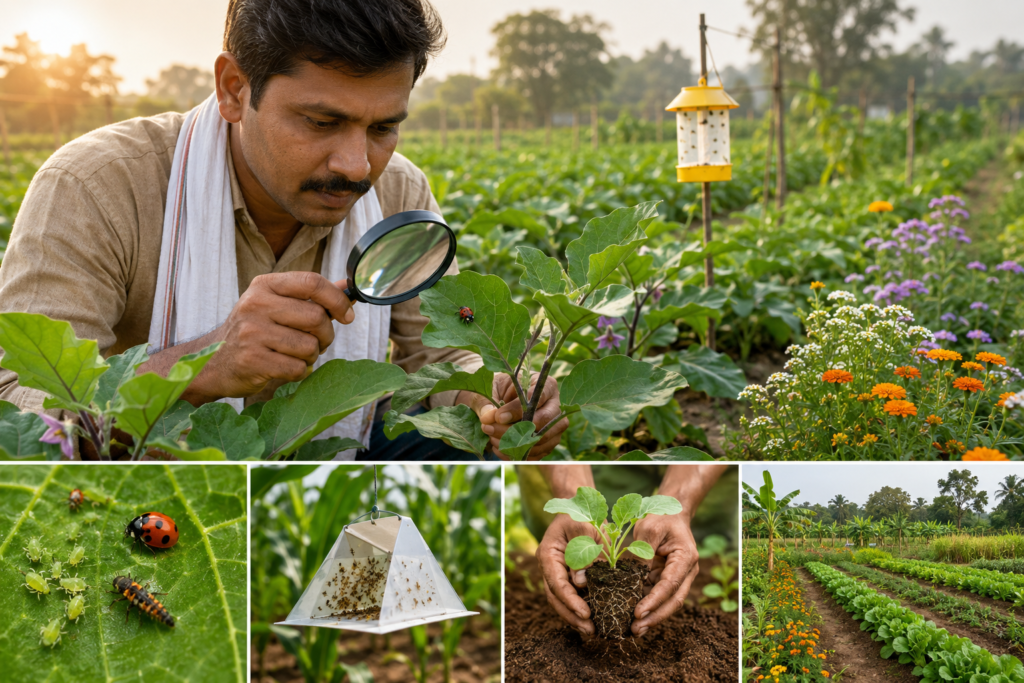
Create a realistic premium agricultural editorial image showing a farmer inspecting healthy green crop leaves with a magnifying glass. Include subtle beneficial insects such as a ladybird beetle, a pheromone trap in the background and a balanced farm ecosystem with flowering border plants. Show crop protection without excessive pesticide spraying. Natural morning light, highly detailed, trustworthy educational style, clean composition, horizontal 16:9 format, no text, suitable for an agriculture website hero image.
FEATURED IMAGE ALT TEXT
Farmer inspecting crops using Integrated Pest Management practices
SUGGESTED INTERNAL LINKS
- Biological Pest Control Methods in Agriculture
- How to Identify Common Crop Pests
- Safe Pesticide Use for Farmers
- Soil Health Management Guide
- Crop Rotation Benefits and Planning
- AI Pest and Disease Identification Tool