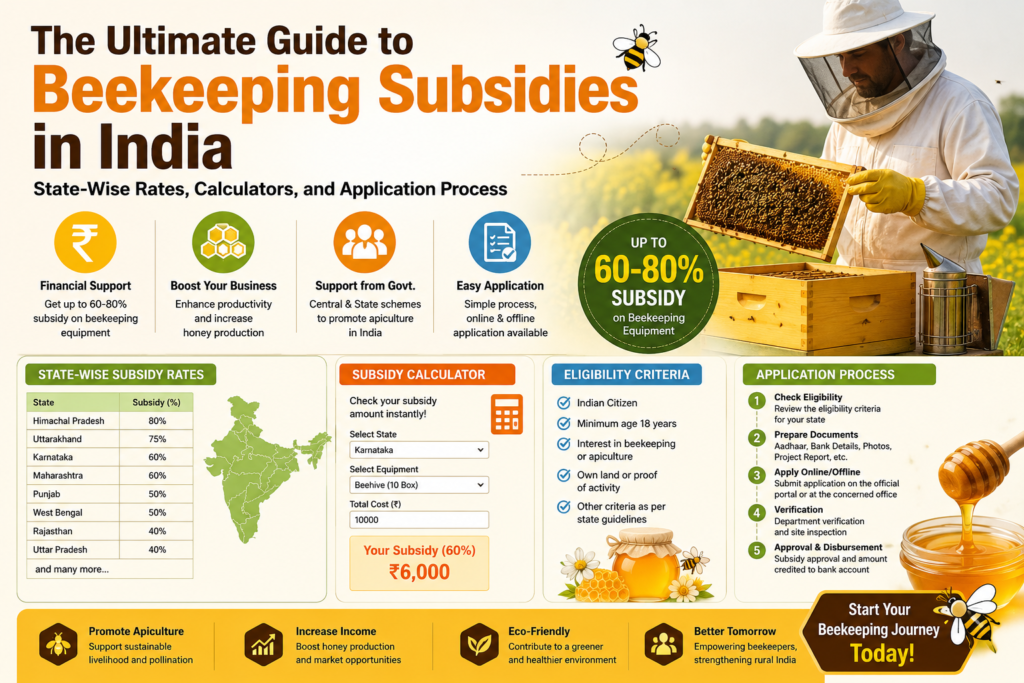
1. Introduction: The Strategic Role of Apiculture in Indian Agriculture
Apiculture has transitioned from a traditional forest-based activity into a strategic pillar of modern Indian agriculture. Beyond the direct production of honey and wax, beekeeping plays a critical role in enhancing crop yields through scientific pollination services—frequently increasing agricultural productivity by 20% to 30% in cross-pollinated crops. For the Indian farmer, it serves as a powerful instrument for income diversification, requiring minimal land while offering high returns on investment. Recognizing this, the Government of India has prioritized the “Sweet Revolution” through robust financial incentives aimed at transitioning hobbyist bee farming into a commercially viable agri-business.
Quick Facts
| Item | Value |
| Scheme | National Beekeeping & Honey Mission (NBHM) |
| Assistance Type | State-wise and category-based |
| Geographic Coverage | All States & UTs |
| Last Updated | July 2026 |
Beekeeping Subsidy at a Glance
| Detail | Typical Range / Value | Notes |
| Subsidy Percentage | 43% to 77% | Varies by state and beneficiary category |
| Maximum Ceiling | ₹1.7 lakh to ₹2.4 lakh | Per beneficiary, state-specific maximum project limits |
| Primary Beneficiaries | Farmers, FPOs, SHGs, Cooperatives | Includes individual and institutional groups |
Understanding the financial support available is the prerequisite for any prospective agri-entrepreneur. Utilizing a subsidy calculator allows for a precise pre-investment analysis, ensuring that the initial capital outlay is optimized.
2. The Beekeeping Subsidy Calculator: Pre-Investment Analysis
Financial planning in the agricultural sector is a vital tool for risk mitigation rather than mere accounting. Before committing capital to equipment and biological assets, it is essential to perform a rigorous pre-investment analysis. A beekeeping subsidy calculator allows stakeholders to project their out-of-pocket expenses accurately, preventing liquidity bottlenecks during the critical first season of operation.
Who Should Use This Calculator?
The calculator is essential for a broad range of stakeholders looking to professionalize apiary operations:
- New Beekeepers: Individuals exploring apiculture as a primary or secondary enterprise.
- Existing Apiary Owners: Professional beekeepers seeking to scale operations by adding more colonies.
- Farmer Producer Organizations (FPOs): Groups establishing collective pollination and collection hubs.
- Women Entrepreneurs: Eligible for specific high-assistance rates to encourage rural female leadership.
Critical Inputs for Accurate Calculation
To obtain a precise estimate, four specific data points are required:
- State/UT: Geographical location dictates specific cost norms and regional subsidy percentages.
- Farmer Category: Classification as either Small & Marginal farmers or General category farmers.
- Social Category: Classification into General, OBC, or SC/ST, as these tiers influence the rate of assistance.
- Box Count: The total number of bee boxes or colonies planned for the project.
By accurately defining these inputs, stakeholders can decode the complex government funding formulas used to support the industry.
3. The Mechanics of Subsidy Calculation: Formulas and Ceilings
Transparency in financial modeling is the hallmark of the National Beekeeping & Honey Mission (NBHM). The government utilizes a standardized formula to ensure funds are distributed equitably across different socio-economic segments.
The Calculation Formula
The fundamental calculation used is: Eligible Project Cost × Subsidy Percentage = Estimated Subsidy
It is critical to note that the “Eligible Project Cost” is determined by state-approved cost norms (e.g., a fixed price per box), rather than the actual market price if the market price exceeds the government benchmark. Furthermore, the result of this formula is strictly subject to state-specific maximum ceilings.
The 3-Step Calculation Process
- Base Cost Determination: Multiply the planned number of boxes by the state-approved cost norm.
- Raw Subsidy Calculation: Apply the beneficiary’s category percentage to the base cost.
- Final Subsidy Application: The final payout is the lower of the raw subsidy or the state’s maximum ceiling (typically ₹1.7 lakh to ₹2.4 lakh).
This mathematical approach ensures that while Small & Marginal farmers receive a higher percentage of support, large-scale commercial projects are managed within the broader policy framework’s budget.
4. Policy Landscape: NBHM, MIDH, and State Variations
The delivery of beekeeping incentives relies on a strategic alignment between central missions and state-level implementation. This synergy allows for a national vision that is adapted to local agricultural realities.
NBHM vs MIDH: A Structural Comparison
| Feature | National Beekeeping & Honey Mission (NBHM) | Mission for Integrated Development of Horticulture (MIDH) |
| Scope | Exclusive focus on beekeeping and apiculture. | Umbrella scheme for all horticultural crops. |
| Relationship | A dedicated mission functioning within MIDH. | The primary framework for horticultural growth. |
| Application | Via State Horticulture Departments. | Via State Horticulture Departments. |
The Role of the NHB and State Initiatives
While the NBHM provides the primary grant structure, the National Horticulture Board (NHB) often backs larger, credit-linked infrastructure projects involving processing and cold storage. Many states also launch their own schemes. For instance, Himachal Pradesh’s Mukhyamantri Madhu Vikas Yojana provides tailored equipment lists and residency-based incentives specifically for the Himalayan terrain.
Central and State Funding Splits
Funding is typically shared between the Union and the State governments:
- Standard States: 60% Central share : 40% State share.
- Northeast & Himalayan States: 90% Central share : 10% State share.
These policy splits directly manifest in the varying subsidy rates across different regions, reflecting the government’s priority to accelerate adoption in ecologically suitable regions.
5. Comprehensive State-Wise Subsidy Rate Analysis
Subsidy rates vary geographically to account for local economic factors, including timber costs for boxes, transport logistics, and regional adoption priorities. The table below outlines the exact indicative rates for nineteen major states.
State-Wise Subsidy Rates (Indicative)
| State | General/OBC | Small & Marginal | SC/ST |
| Maharashtra | 57% | 68% | 74% |
| Telangana | 50% | 60% | 65% |
| Karnataka | 52% | 62% | 68% |
| Tamil Nadu | 55% | 66% | 72% |
| Kerala | 50% | 60% | 65% |
| Andhra Pradesh | 48% | 58% | 62% |
| Gujarat | 52% | 62% | 67% |
| Rajasthan | 58% | 70% | 76% |
| Punjab | 48% | 58% | 62% |
| Haryana | 45% | 53% | 58% |
| Uttar Pradesh | 49% | 59% | 64% |
| Madhya Pradesh | 58% | 70% | 76% |
| Bihar | 57% | 69% | 74% |
| West Bengal | 46% | 56% | 60% |
| Odisha | 59% | 71% | 77% |
| Assam | 43% | 52% | 56% |
| Himachal Pradesh | 47% | 56% | 61% |
| Uttarakhand | 56% | 67% | 72% |
| Jammu and Kashmir | 58% | 70% | 76% |
A significant premium—typically between 14 to 20 percentage points—is offered to SC/ST and Small & Marginal farmers. This tiered approach is designed to encourage equitable growth and lower the entry barrier for traditionally marginalized communities.
6. Beneficiary Segmentation and Impact Analysis
The government’s use of tiered subsidy rates is a deliberate strategy to incentivize specific social groups and smaller landholders. By providing higher percentages of support to those with fewer resources, the policy ensures inclusive rural development.
Typical Subsidy by Beneficiary Type
| Beneficiary | Typical Subsidy Range |
| General | 43% – 59% |
| Small & Marginal | 52% – 71% |
| SC/ST | 56% – 77% |
| SHG / FPO | State-specific/Higher institutional rates |
These rates are strictly enforced to ensure the maximum social impact is achieved per rupee of government expenditure.
7. Eligibility Criteria and Documentation Framework
To maintain the integrity of the Direct Benefit Transfer (DBT) system, a rigorous documentation framework is in place to ensure assistance reaches genuine practitioners.
Who Can Apply?
- Individual farmers and beekeepers.
- Self-Help Groups (SHGs) and Cooperatives.
- Farmer Producer Organizations (FPOs).
- Note: Landless farmers are eligible via lease agreements or written permission for apiary sites.
Documentation Requirements
| Document | Purpose |
| Aadhaar Card | Identity verification. |
| Land/Lease Proof | Verification of apiary site suitability. |
| Bank Passbook (IFSC) | Essential for fund transfer via DBT. |
| Caste Certificate | Required for SC/ST/OBC category claims. |
| KVK Training Certificate | Proof of 5-7 day mandatory training. |
CRITICAL SUCCESS FACTOR: The KVK Training Certificate is non-negotiable in most states. Ensure this is completed before application to avoid immediate rejection.
Document mismatches, especially regarding bank details and IFSC codes, are the primary cause of funding delays.
8. Eligible Investment Components and Biological Assets
A comprehensive subsidy covers the entire production ecosystem, not just the hardware. It is designed to support the biological assets and tools necessary for commercial-grade honey production.
Covered Investment Expenses
- Biological Assets: Bee colonies and queen bees (nucleus stock).
- Hardware: Bee boxes, honey extractors, and filtration units.
- Maintenance: Wax processing equipment and pollen traps.
- Protective Gear: Suits, gloves, and veils.
- Post-Harvest: Storage drums and small packaging units.
Comparison of Bee Species
| Species | Characteristics | Policy Implication |
| Apis mellifera | European bee; high yield; commercial focus. | Carries a higher cost norm due to colony price. |
| Apis cerana indica | Native Indian bee; resilient; smaller scale. | Lower cost norm; suited for hilly regions. |
Linking these components to their state-approved costs is vital for accurate budgeting in a scaled project model.
9. Scaled Project Cost Guide
Economies of scale are critical in apiculture; however, as the installation grows, the state subsidy ceiling begins to cap the total financial assistance available.
Illustrative Project Costs vs. Subsidies
(Based on a ₹3,700 per box cost norm at a 55% subsidy rate)
| Number of Boxes | Total Project Cost | Estimated Subsidy |
| 20 Boxes | ₹74,000 | ₹40,700 |
| 50 Boxes | ₹1,85,000 | ₹1,01,750 |
| 100 Boxes | ₹3,70,000 | ₹2,03,500* |
| 200 Boxes | ₹7,40,000 | Capped by State Ceiling |
*Note: In most states, the ₹2,03,500 figure for 100 boxes is already nearing the common ₹1.7L–₹2.4L ceiling. Beyond this point, the beekeeper’s personal contribution increases as a percentage of the total project cost.
10. Commercial Viability: The 50-Box Profitability Model
Return on Investment (ROI) is significantly accelerated by the subsidy, which lowers the initial break-even point. A 50-box unit is the recommended starting point for commercial viability.
The 50-Box Financial Model
- Base Project Cost: ₹1,85,000
- Government Subsidy (55%): ₹1,01,750
- Out-of-Pocket Investment: ₹83,250
- Annual Revenue Projection: 50 boxes x 20kg/box @ ₹350/kg = ₹3,50,000.
Note: The projected revenue excludes Running Costs (sugar feeding during lean periods, medication, and labor). When these are deducted from the gross profit, the subsidy still allows for the recovery of the farmer’s initial contribution within the first season.
11. The Application Lifecycle and Vendor Compliance
A strict procedural timeline is employed to prevent fraud and ensure high-quality biological and technical assets are utilized.
The 7-Step Timeline
- Application: Online or district office submission.
- Verification: Administrative document review.
- Site Inspection: Field check for forage and site suitability.
- Approval: Sanctioned work order issued.
- Purchase: Procurement from approved vendors only.
- Invoice: Submission of GST invoices and photos.
- DBT: Final credit to the bank account.
Strict Vendor Compliance
CRITICAL SUCCESS FACTOR: Geo-tagged photographs of the installed boxes and original GST invoices from NBB/State-approved vendors are mandatory. Purchases from unlisted vendors will result in the immediate forfeiture of the subsidy.
The best time to apply is just prior to peak honey flow to maximize verification efficiency.
12. Integrated Financing: NABARD, KVIC, and Bank Linkages
Credit-linked subsidies are essential for scaling apiculture into a larger commercial enterprise.
- NBHM Route: Primarily grant-based, focusing on a percentage of project costs.
- NABARD/KVIC Route: Focused on loan-cum-subsidy models.
- Crucial Distinction: NABARD is a refinance agency, not a direct lender. It refinances the banks that provide beekeeping loans to farmers.
These instruments can be combined to cover the remaining balance of the project cost through a term loan, typically repayable over 3 to 7 years.
13. Risk Mitigation: Common Mistakes and Rejection Factors
A “right-first-time” application strategy is essential to avoid bureaucratic backlogs.
Common Mistakes
| Mistake | Consequence |
| Wrong Category Selection | Results in lower subsidy or rejection. |
| Incorrect Cost Norms | Projections won’t match government payouts. |
| Missing Training | Application stalled until KVK certificate is provided. |
Reasons for Rejection
- Unsuitable Forage Site: Lack of flowering crops during site inspection.
- Unapproved Vendors: Buying from non-notified suppliers.
- Duplicate Claims: Attempting to subsidize the same box twice.
14. Frequently Asked Questions (FAQ)
- What is the maximum subsidy for bee farming? Most states cap the subsidy between ₹1.7 lakh and ₹2.4 lakh per beneficiary.
- Is the beekeeping subsidy different in every state? Yes. Cost norms and percentages are set independently by each state horticulture department.
- Can landless farmers apply? Yes. A lease agreement or permission to use a farm boundary is sufficient.
- Can I apply online? Yes, via most State Horticulture Department portals.
- Can I combine central and state subsidies? No. You cannot claim two different subsidies for the same project component.
- Can I take a bank loan and a subsidy together? Yes. The subsidy is a grant, and a NABARD-linked loan funds the balance.
- How long does approval take? Typically a few weeks to a few months, depending on inspection schedules.
- Does NABARD directly finance farmers? No. NABARD provides refinance to banks and supports training via KVKs.
- Can I move my apiary to another state? Generally no; subsidies are tied to the specific site inspected during approval.
- Can I apply for a second subsidy? Only for new, separate components; not for the same boxes.
- Is GST included? Usually, subsidies are calculated on pre-tax base costs. Verify with your state’s current guidelines.
- Can I increase boxes after approval? No. Sanctions are fixed; increases require a new application.
- What if project costs exceed the limit? The subsidy is capped at the state ceiling; the surplus is the farmer’s responsibility.
- How accurate is the calculator? It provides estimates based on current data; always verify with local officials before purchase.
- Where do I get training? Free training is available at Krishi Vigyan Kendras (KVK).
15. Official Resources and Conclusion
Government support is transforming beekeeping from a traditional hobby into a high-value agri-business. By leveraging these subsidies, Indian farmers can build resilient enterprises that contribute to personal wealth and