
1. Strategic Overview: The Agricultural Value of the Pumpkin
Pumpkins represent a significant agricultural asset, serving as a high-value crop for both large-scale commercial operations and premium backyard gardens. Their strategic importance stems from their remarkable market versatility; they are uniquely positioned to serve the culinary industry, the seasonal decorative market, and the specialized niche of competitive giant-pumpkin growing. Beyond their economic value, pumpkins are nutritionally dense, providing high levels of Vitamin A, potassium, and fiber.
Successful cultivation is predicated on meeting specific biological requirements, most notably the necessity for a long, frost-free growing season ranging from 75 to 100 days. As tender members of the Cucurbitaceae family, they require consistent warmth, high light levels, and protection from cold winds. The foundation of a productive yield, however, begins with the procurement of high-quality genetic material, as the choice of cultivar dictates the ultimate marketability and performance of the crop.
2. Cultivars and Selection: Aligning Variety with Market Intent
Variety selection is the most critical decision a grower faces, as it governs the entirety of the management cycle—from space requirements and irrigation needs to the final market destination. A misalignment at this stage can result in unmarketable inventory or a crop that outgrows its allocated environment.
The following table categorizes primary cultivars based on their physical characteristics and intended end-use:
| Category | Specific Cultivars | Key Characteristics | Primary Use |
| Large Carving | Autumn Gold, Connecticut Field, Spirit Hybrid, Charmant, Cargo | 6–25 lbs; bright orange; uniform shape; thick stems | Halloween lanterns, versatile commercial use |
| Miniature | Jack Be Little, Wee-B-Little, Baby Bear | 0.5–1.5 lbs; palm-sized; compact growth habits | Table displays, individual decorations, baking |
| Giant / Competition | Atlantic Giant, Big Max, Big Moon, Hundredweight | Can exceed 200 lbs; vigorous vines; red-orange skin | Agricultural shows, competitions, roadside attractions |
| Culinary / Baking | Sugar Pie, Small Sugar | High sugar content; low moisture; dense cell structure | Pies, soups, ravioli, oil extraction |
| Unique Heirlooms | Lumina (White), Rouge Vif d’Etampes, Musquée de Provence, Galeux d’Eysines | 8–14 lbs (Lumina); diverse colors (white, blue, red) and warty textures | Gourmet cooking, painting, premium ornamental displays |
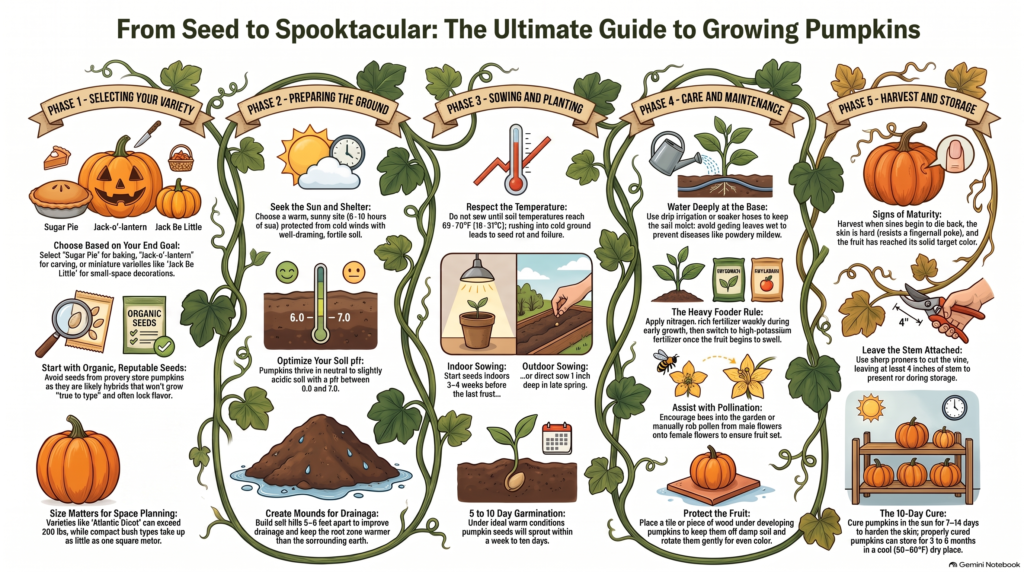
From a biological perspective, culinary varieties like ‘Sugar Pie’ differ significantly from carving types such as ‘Connecticut Field’. Baking varieties are bred for a dense cell structure and lower water content, which concentrates sugars and provides a superior texture for processing. In contrast, carving varieties often possess a higher water-to-pulp ratio and a thinner wall, making them easier to hollow out but far less flavorful for culinary applications. Regardless of the intended market, the integrity of the seed itself remains the primary driver of success.
3. The Science of Sourcing: Genetic Purity and Professional Standards
Sourcing seeds requires strict adherence to professional standards due to the high risk of cross-pollination within the Cucurbitaceae family. Pumpkins are notorious for interbreeding with other squashes, which can lead to genetic “mish-mashes” that lack the desirable traits of either parent.
Saving seeds from grocery-store pumpkins or compost “volunteers” is a high-risk endeavor that typically yields poor results. Such seeds often produce hybrid offspring—for example, a pumpkin-spaghetti-squash cross—that possesses the flavor and texture of neither, resulting in fruit with no culinary or decorative value. To ensure genetic purity and high germination rates, growers should utilize professional suppliers who adhere to rigorous testing:
- Harris Seeds: Maintains an in-house germination lab following AOSA (Association of Official Seed Analysts) standards to ensure rates exceed federal and state requirements.
- Johnny’s Selected Seeds: A founding signatory of the Safe Seed Pledge; offers extensive organic and conventional options with detailed maturity and weight charts.
- Osborne Quality Seeds: Provides non-GMO certifications and is organic-certified by the Washington State Department of Agriculture (WSDA).
- Gurney’s Seed and Nursery Co.: Utilizes a 20-acre research farm for independent evaluations and provides a full one-year product guarantee.
Establishing a high-quality genetic foundation allows the grower to transition confidently to the physical preparation of the growing environment.
4. Environmental Foundations: Soil Science and Site Preparation
The relationship between soil health and drainage is paramount in preventing water-borne pathogens. An ideal site must offer 6–10 hours of full sunlight daily and be well-sheltered from cold winds.
The preferred soil is a moisture-retentive but well-drained medium with a slightly acidic to neutral pH between 6.0 and 6.5. Because pumpkins require warm soil (minimum 65°F/18°C) for successful emergence, I explicitly advise the use of a soil thermometer to bridge the gap between calendar dates and actual thermal readiness. Prepare “mounds” (or hills) using the following protocol:
- Residue Removal: Remove the top 4 inches of organic residue and plant debris; this material often harbors water molds like Pythium and restricts air circulation.
- Soil Amending: Incorporate finished compost, well-rotted manure, and wood ash to provide a nutrient-dense base.
- Pathogen Protection: Incorporate a neem solution into the soil to act as a natural deterrent for soil-borne insects and pathogens.
- Mound Construction: Construct a slightly raised mound with a central depression to facilitate efficient water management and heat retention.
Spacing must be determined by the variety’s growth habit: trailing varieties require 1.5 meters (5 feet) between mounds, while compact bush varieties can be spaced 90 centimeters (3 feet) apart to ensure adequate airflow.
5. Sowing Protocols: Timing, Temperature, and Lunar Influence
Pumpkin seeds are highly thermally sensitive; rushing planting into cold ground inevitably leads to seed rot.
Indoor Start Protocol
For northern or cold-temperate climates, start seeds indoors 3–4 weeks before the last frost to maximize the growing window.
- Container: Use biodegradable pots (peat or newspaper) to ensure minimal root disturbance during transplanting.
- Orientation: Sow seeds on their edge (side) at a depth of 1 cm. Sowing on the flat side allows water to sit on the seed surface, significantly increasing the risk of rot.
- Thermal Control: While 18–21°C (65–70°F) is the absolute minimum for success, the ideal germination temperature is 30–32°C (86–90°F). Utilize a heated propagator to maintain these professional standards.
Outdoor Direct Sow Protocol
Direct sowing is often preferred to avoid transplant shock once the risk of frost has passed.
- Soil Temperature: Wait until the soil reaches 25–35°C (77–95°F).
- Depth: Sow 3–4 seeds per mound at a depth of 1 inch.
- Thinning: Once established, thin the group to the single strongest seedling.
The Lunar Phase Strategy
Professional agriculturists recommend sowing during the second lunar phase. During this window, the increasing intensity of moonlight serves as a specific driver for leaf growth, while minimal gravitational pull facilitates early plant development.
6. Active Crop Management: Nutrition, Hydration, and Training
Pumpkins are “heavy feeders” requiring precise nutritional intervention to reach their full genetic potential.
- Irrigation: Mandate deep watering at the soil line once per week. I recommend deep drenching to ensure moisture reaches the full depth of the root zone and to help flush out excess salts from the soil. Overhead watering must be strictly avoided to prevent foliar diseases.
- Fertilization: Apply nitrogen-rich feeds (liquid manure or compost tea) during the early vine-building stage. Once the fruit begins to swell, shift to a high-potassium liquid fertilizer every 10–14 days to support fruit development and lignification.
Vine and Fruit Management
Regularly prune vines to direct energy towards the fruit and remove yellowing leaves to maintain airflow. For compact types, use sturdy arches or trellises. Ground-level fruit should be placed on a barrier—such as a tile, brick, or piece of wood—to prevent rot caused by damp soil contact.
Pollination Protocol
While bees are primary pollinators, manual intervention is often necessary. Identify the female flower (distinguished by the small ovary or “mini-fruit” at the base) and the male flower (the pollen provider on a slender stalk). Vigorously rub the male flower’s pollen over the female flower’s stigma to ensure fruit set.
7. Pathogen and Pest Defence: Organic Intervention Strategies
Cucurbits are highly vulnerable to pathogens that can stymie a crop just before maturity.
Threat Matrix & Organic Control Directives:
- Water Moulds (Phytophthora, Pythium, Rhizoctonia):
- Control: Improve drainage, remove the top 4 inches of surface residue, and avoid planting until soil temperatures meet requirements.
- Powdery Mildew:
- Control: Ensure strict 1.5m spacing for airflow, avoid overhead irrigation, and implement early removal of affected leaves.
- Grey Mould (Botrytis):
- Control: Improve air circulation around the fruit and immediately remove and destroy any decaying plant tissues.
- Insects (Squash bugs, Aphids, Leaf miners, Ants):
- Control: Apply neem-based organic repellents and manually remove affected foliage or egg masses early in the season.
8. Harvest and Post-Harvest: Curing for Longevity
The harvest is a critical transition where chemical changes determine storage lifespan. Harvesting must occur before the first hard frost, as frosted tissue is prone to rapid decay.
Harvest Protocol
- Selection: Harvest only when the fruit has achieved its full cultivar color and the vine has begun to dry and die back.
- Technique: Use sharp, sterilized pruners. Maintain at least 10 centimeters (4 inches) of stem. Never “rip” the fruit from the vine; jagged stem ends provide an entry point for pathogens.
Curing and Storage
- Curing: Place pumpkins in the sun (or a warm, sunny window) for 1–2 weeks. This period is vital for the lignification of the skin (hardening) and allows for the internal conversion of starches to sugars, which improves culinary quality.
- Storage: Move cured pumpkins to a well-ventilated, frost-free space maintained at 10–15°C (50–60°F).
- Longevity: Most varieties will store for 3–6 months. It is imperative that fruits do not touch during this period; a single point of contact can facilitate the spread of rot through an entire inventory.
Adhering to these authoritative protocols transforms a simple seed into a high-value agricultural asset, ensuring a harvest characterized by genetic purity, structural integrity, and long-term viability.