
Agriculture is entering a new technological era.
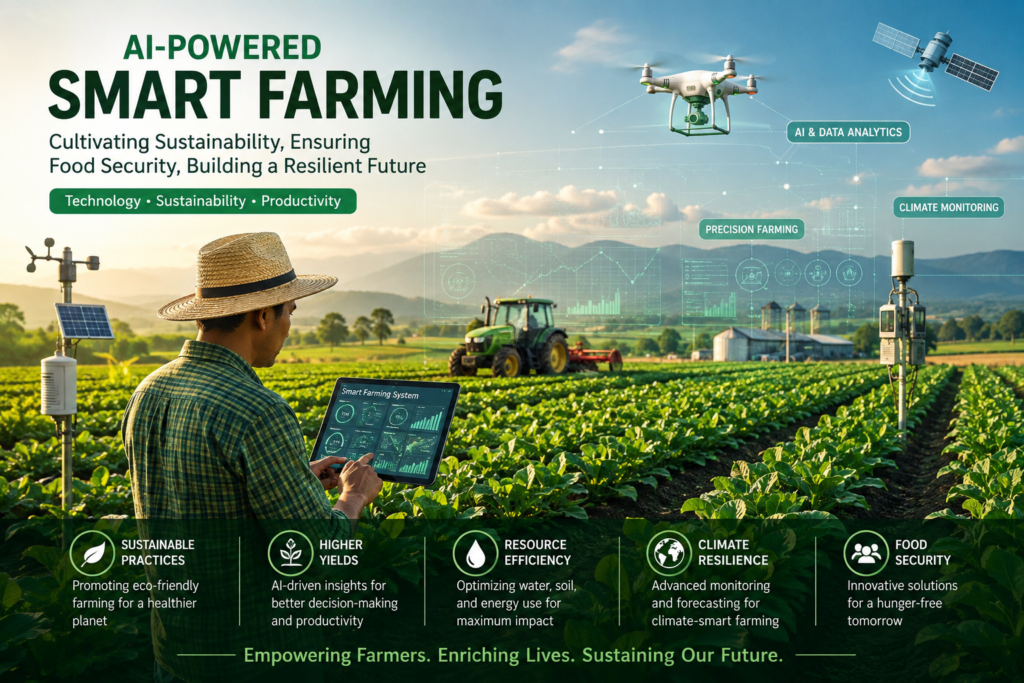
For generations, farmers have relied on experience, traditional knowledge, seasonal patterns and observation of their fields to make critical decisions. But farming conditions are changing rapidly. Weather patterns are becoming less predictable, water resources are under pressure, input costs are rising, soil health is deteriorating in many regions, and farmers increasingly need to produce more food with fewer resources.
This is where AI-powered smart farming and climate technology are becoming increasingly important.
Artificial intelligence, satellite imagery, drones, Internet of Things (IoT) sensors, weather forecasting, remote sensing, robotics, digital advisory platforms and farm-management software are changing how agricultural decisions can be made.
Instead of treating an entire farm in exactly the same way, technology can help farmers understand what is happening in different parts of a field and respond more precisely.
The goal is not to replace farmers.
The goal is to give farmers better information so they can make better decisions.
The Food and Agriculture Organization of the United Nations (FAO) says digital agriculture and AI can support precision farming, climate-smart agriculture, supply-chain optimization and market access while contributing to more efficient and resilient agrifood systems.
This transformation is particularly important for countries such as India, where millions of farmers operate small and fragmented holdings and where agriculture remains highly exposed to weather, water availability and market risks.
India is already building a national digital agriculture ecosystem. The Government of India approved the Digital Agriculture Mission in September 2024 with an outlay of ₹2,817 crore, including initiatives such as AgriStack, the Krishi Decision Support System and soil-profile mapping.
The future of farming will therefore not simply be about tractors and machinery.
It will increasingly be about data + science + technology + farmer experience.
Table of Contents
- What Is AI-Powered Smart Farming?
- Why Agriculture Needs Smart Technology
- How Artificial Intelligence Is Used in Agriculture
- AI-Based Crop Monitoring
- AI for Pest and Disease Detection
- AI-Powered Irrigation and Water Management
- Smart Soil Management
- Weather Forecasting and Climate Risk
- Satellite Imagery and Remote Sensing
- Agricultural Drones
- IoT Sensors and Connected Farms
- Robotics and Automation
- Digital Agricultural Advisory Services
- AI and Crop Yield Prediction
- AI in Livestock Farming
- AI for Supply Chains and Markets
- AI and Climate-Smart Agriculture
- How Smart Farming Can Improve Food Security
- AI-Powered Agriculture in India
- AgriStack and India’s Digital Agriculture Mission
- Benefits for Small and Marginal Farmers
- Challenges and Risks of AI in Agriculture
- The Digital Divide in Rural Areas
- Data Privacy and Farmer Data
- Why Human Expertise Still Matters
- The Future of AI Farming
- Practical Smart Farming Roadmap for Farmers
- Frequently Asked Questions
- Conclusion
What Is AI-Powered Smart Farming?
AI-powered smart farming refers to the use of artificial intelligence and connected technologies to collect agricultural information, analyze it and support better farm-management decisions.
A smart farming system can combine information from:
- Soil sensors
- Weather stations
- Satellites
- Drones
- Farm machinery
- Mobile phones
- Crop images
- GPS
- Historical yield records
- Market information
- Remote-sensing systems
AI algorithms can then analyze these datasets and identify patterns.
For example, an AI system might identify that a particular area of a field is experiencing water stress while another section has sufficient moisture.
Instead of irrigating the entire field equally, the farmer may be able to target irrigation where it is actually needed.
This principle is at the heart of precision agriculture.
Traditional approach:
Farm → Same treatment → Same irrigation → Same fertilizer
Smart farming approach:
Farm → Data collection → Analysis → Targeted decision → Precise application
The result can be more efficient use of water, fertilizer, pesticides, labour and energy.
However, AI recommendations should not automatically be treated as agricultural truth. They need to be validated against local conditions, crop stage, soil characteristics and expert agronomic knowledge.
Why Does Agriculture Need Smart Technology?
Agriculture faces several interconnected challenges.
Climate change can increase the frequency and intensity of droughts, floods, heat stress and irregular rainfall. Farmers must also deal with pests, diseases, soil degradation, labour shortages, rising input prices and uncertain markets.
At the same time, global food systems must continue producing sufficient nutritious food.
The challenge is therefore:
How can farmers produce more efficiently while protecting natural resources and becoming more resilient to climate shocks?
Technology can contribute to the answer.
FAO’s recent work on digital agriculture emphasizes that AI and digital tools can help improve resource efficiency and resilience, but successful transformation also requires inclusive access and attention to the rural and digital divides.
Smart farming can help farmers move from reactive agriculture toward more predictive agriculture.
Instead of asking:
“What happened to my crop?”
Farmers can increasingly ask:
“What is likely to happen, and what can I do before it becomes a serious problem?”
That shift could be extremely valuable.
How Artificial Intelligence Is Used in Agriculture
Artificial intelligence can process huge quantities of agricultural data much faster than a person manually analyzing every data point.
AI applications in agriculture include:
Crop monitoring: Identifying crop stress from images and satellite data.
Disease detection: Analyzing leaf photographs for potential disease symptoms.
Pest forecasting: Combining weather, crop-stage and historical information to estimate pest risk.
Irrigation management: Using soil moisture and weather information to support irrigation decisions.
Yield prediction: Estimating potential crop production using historical and current field information.
Weather intelligence: Turning weather data into farm-specific recommendations.
Farm automation: Supporting autonomous machinery, robotic systems and precision operations.
Market intelligence: Analyzing prices, demand and supply patterns.
Digital advisory: Providing farmers with information through mobile applications, websites, chatbots and voice systems.
Generative AI adds another layer.
Farmers may eventually be able to interact with agricultural AI systems through natural language:
“My chilli leaves are curling. What should I check first?”
The system could ask for a photograph, crop age, location, weather conditions and recent pesticide applications before providing a structured diagnosis.
That is potentially much more useful than a generic agricultural article.
AI-Based Crop Monitoring
One of the most promising applications of AI is crop monitoring.
Large farms can contain thousands or millions of individual plants. Human inspection of every plant is practically impossible.
Computer vision and remote sensing can help identify changes in vegetation.
For example, an AI system could analyze imagery to identify:
- Areas with poor crop growth
- Water stress
- Nutrient-related symptoms
- Pest damage
- Disease patterns
- Weed infestation
- Storm damage
- Flooding
- Uneven crop establishment
Satellite images can provide large-scale monitoring, while drones can provide higher-resolution information.
A farmer could therefore move from randomly inspecting a field to inspecting areas that the technology has identified as potentially problematic.
This does not eliminate field scouting.
Instead, it can make field scouting more targeted.
AI for Pest and Disease Detection
Crop pests and diseases can cause significant economic losses when they are not identified early.
Traditional pest management often depends on farmers noticing visible symptoms.
By the time symptoms become obvious, however, the problem may already have spread.
AI-powered computer vision systems can analyze photographs of leaves, stems, fruits and insects.
A farmer could potentially take a photograph using a smartphone and receive information about possible problems.
But there is an important limitation.
An AI diagnosis is not automatically a confirmed diagnosis.
Different diseases can produce similar symptoms. Nutrient deficiencies can sometimes resemble disease symptoms. Weather damage can also look like pest damage.
Therefore, AI should ideally work as a decision-support tool, not as an unquestionable replacement for agricultural experts.
The best systems should provide:
- Possible diagnosis
- Confidence level
- Additional questions
- Recommended field checks
- Preventive options
- Warnings when professional confirmation is necessary
This approach can make agricultural AI safer and more useful.
AI-Powered Irrigation and Water Management
Water is one of agriculture’s most important resources.
Traditional irrigation may be based on fixed schedules.
For example:
“Water every three days.”
But crop water requirements can change according to:
- Temperature
- Humidity
- Wind
- Soil type
- Crop stage
- Rainfall
- Evapotranspiration
- Root-zone moisture
Smart irrigation systems can combine these variables.
IoT soil-moisture sensors can measure moisture at different depths.
Weather systems can estimate upcoming rainfall.
AI can combine this information and help determine whether irrigation is required.
This could reduce unnecessary irrigation.
In regions facing groundwater depletion or water scarcity, such technology could become increasingly important.
India is already seeing practical experimentation in this area. In May 2026, ICAR’s Research Complex for Eastern Region reported the establishment of an indigenous IoT-enabled soil-monitoring system aimed at addressing erratic rainfall, groundwater decline, irrigation energy costs and inefficient water application.
This demonstrates that smart farming is moving beyond theory toward real agricultural applications.
Smart Soil Management
Healthy soil is the foundation of productive agriculture.
Yet farmers often apply fertilizer based on general recommendations rather than precise field-level information.
Smart agriculture can improve soil management by combining:
- Soil testing
- Soil moisture sensors
- Nutrient information
- Crop history
- Yield data
- Remote sensing
- Weather information
AI can potentially identify relationships between these variables.
For example, a farmer may discover that a particular field section consistently produces lower yields.
Instead of simply increasing fertilizer across the entire field, soil testing and mapping could identify whether the problem is related to nutrient imbalance, drainage, compaction, salinity or another factor.
This can support more precise nutrient management.
The objective should not be:
Use more technology.
The objective should be:
Use the right information to use inputs more efficiently.
Weather Forecasting and Climate Risk
Weather is one of agriculture’s biggest uncertainties.
A few days of extreme heat, unexpected rainfall or prolonged dry conditions can significantly affect crop performance.
Modern agricultural technology can combine weather forecasts with crop and field data.
Potential applications include:
- Rainfall alerts
- Frost alerts
- Heat-wave warnings
- Irrigation recommendations
- Disease-risk alerts
- Pest-risk forecasting
- Harvest planning
- Storm preparation
- Flood-risk monitoring
Climate intelligence becomes particularly valuable when it is translated into an action.
Instead of simply telling a farmer:
“Heavy rainfall expected tomorrow.”
A useful agricultural system might say:
“Heavy rainfall is expected within 24 hours. Consider delaying irrigation and avoid unnecessary field operations where possible.”
The technology becomes valuable when complex data becomes a practical decision.
Satellite Imagery and Remote Sensing
Satellites provide an extraordinary view of agricultural landscapes.
Remote-sensing systems can help monitor vegetation, land use, soil characteristics, water bodies and crop conditions.
Satellite data can be used for:
- Crop-area estimation
- Drought monitoring
- Flood assessment
- Vegetation monitoring
- Crop-health analysis
- Irrigation planning
- Disaster assessment
- Yield estimation
When combined with AI, satellite data can become even more useful.
A computer can process thousands of images and identify changes that would be difficult to observe manually.
India’s Digital Agriculture Mission includes the Krishi Decision Support System, which incorporates geospatial and related agricultural information to support decision-making.
This is an important step toward building agricultural intelligence at national scale.
Agricultural Drones
Drones are another important component of smart farming.
Agricultural drones can be used for:
- Crop monitoring
- Mapping
- Imaging
- Targeted spraying
- Field inspection
- Nutrient assessment
- Pest surveillance
- Stand-count estimation
Drone imagery can provide much more detailed information than many satellite systems.
Drones can also reduce the need for workers to physically inspect large areas.
ICAR has highlighted agricultural drones, robots, soil sensors, remote sensing, GIS, AI/ML and IoT as technologies contributing to more precise and climate-smart agricultural systems.
However, drone use should comply with applicable aviation and agricultural regulations, and pesticide applications should follow product labels and safety requirements.
IoT Sensors and Connected Farms
The Internet of Things connects physical devices to digital systems.
In agriculture, sensors can measure:
- Soil moisture
- Temperature
- Humidity
- Rainfall
- Water levels
- Electrical conductivity
- Greenhouse conditions
The information can be transmitted to a dashboard or mobile application.
Farmers can then monitor field conditions remotely.
Imagine a farmer receiving a notification:
“Soil moisture in Field 3 has fallen below the configured threshold.”
That information can be more useful than simply following a fixed irrigation schedule.
In greenhouse farming, IoT can also help control:
- Ventilation
- Temperature
- Humidity
- Irrigation
- Lighting
- Nutrient delivery
The long-term direction is toward connected farms where physical conditions are continuously monitored.
Robotics and Automation in Agriculture
Labour availability is a growing challenge in many agricultural regions.
Robotics could help automate repetitive operations.
Potential applications include:
- Autonomous tractors
- Robotic weed removal
- Automated harvesting
- Robotic milking
- Fruit picking
- Precision seeding
- Automated greenhouse operations
Robotics may be particularly useful for high-value crops where labour costs represent a significant portion of production expenses.
But the economic question is critical.
A technologically advanced machine is not automatically a good investment for every farmer.
Farmers need to consider:
Purchase cost + maintenance + training + operating cost + expected savings/income.
Custom hiring centres, farmer producer organizations and agricultural service providers could make expensive technologies more accessible to smallholders.
Digital Agricultural Advisory Services
One of the biggest opportunities for AI is agricultural advice.
Many farmers cannot easily access agricultural experts whenever they need help.
Digital advisory platforms can potentially provide information through:
- Mobile apps
- Websites
- Voice assistants
- Chatbots
- SMS
- Regional-language platforms
This is especially important in countries such as India.
An AI agricultural assistant could communicate in Telugu, Hindi, Tamil, Kannada, Marathi, Bengali and other regional languages.
A farmer could ask:
“When should I irrigate my cotton crop?”
The system could consider crop stage, local weather, soil conditions and available irrigation information before generating a response.
However, the system must clearly distinguish between:
General information
and
location-specific professional recommendations.
That distinction is essential for responsible agricultural AI.
AI and Crop Yield Prediction
Yield prediction is another major application.
Farm yields depend on numerous variables:
- Variety
- Soil
- Weather
- Irrigation
- Fertilizer
- Pest pressure
- Disease
- Plant population
- Crop management
AI models can analyze historical and current information to estimate possible yield.
Yield prediction can benefit:
Farmers: Planning harvest and storage.
Governments: Estimating food production.
Insurers: Assessing agricultural risks.
Processors: Planning procurement.
Traders: Understanding supply expectations.
Researchers: Studying climate impacts.
But yield prediction should always be presented as an estimate, not a guarantee.
Weather conditions can change rapidly, and agricultural systems contain significant uncertainty.
AI in Livestock Farming
Smart agriculture is not limited to crops.
AI and IoT can also support livestock management.
Sensors and cameras can potentially monitor:
- Animal movement
- Feeding behaviour
- Body temperature
- Milk production
- Weight
- Reproductive behaviour
- Disease indicators
Early detection of unusual behaviour may allow farmers or veterinarians to investigate problems sooner.
Automated systems can also help manage feeding and environmental conditions.
For dairy farms, data-driven monitoring can improve herd management and operational efficiency.
Again, technology should complement veterinary expertise rather than replace it.
AI for Agricultural Supply Chains and Markets
Farm productivity is only one part of food security.
A farmer can produce an excellent crop and still lose money because of:
- Poor market timing
- Post-harvest losses
- Lack of storage
- Transportation problems
- Price volatility
- Limited buyer access
Digital platforms can help connect farmers with:
- Buyers
- Markets
- Warehouses
- Transport providers
- Financial services
- Processing units
AI can potentially analyze historical price information and supply-demand patterns.
In India, the government’s Digital Agriculture Mission includes digital infrastructure intended to support farmer-centric services, while e-NAM provides a digital marketplace connecting agricultural markets.
The future of agricultural technology therefore needs to extend beyond the farm gate.
AI and Climate-Smart Agriculture
Climate-smart agriculture aims to address three broad goals:
- Maintain or improve agricultural productivity.
- Build resilience to climate change.
- Where possible, reduce agricultural greenhouse-gas emissions.
AI can support these objectives through better resource management.
For example:
Water: Irrigate based on actual crop requirements.
Fertilizer: Apply nutrients more precisely.
Pesticides: Improve pest monitoring and targeted intervention.
Crops: Identify varieties and practices better suited to local conditions.
Weather: Provide early warnings.
Soil: Monitor degradation and moisture.
Livestock: Improve feed and animal-health management.
Climate-smart agriculture is therefore not simply about installing sensors.
It is about using better information to make farming systems more resilient.
How Smart Farming Can Improve Food Security
Food security depends on more than producing enough food.
It also involves access, affordability, stability and nutrition.
Smart farming can contribute by improving agricultural efficiency and resilience.
Potential benefits include:
Higher productivity: Better decisions can improve crop management.
Reduced input waste: Precision application can prevent unnecessary use of water, fertilizer and chemicals.
Climate resilience: Early warnings can help farmers prepare for weather risks.
Reduced losses: Better harvesting, storage and supply-chain planning can reduce waste.
Improved market access: Digital platforms can connect producers and buyers.
Faster agricultural advice: Farmers can access information more quickly.
Better policy decisions: Governments can use agricultural data for planning.
FAO’s 2025 disaster assessment reported agricultural losses of approximately USD 3.26 trillion between 1991 and 2023, illustrating the scale of the challenge facing agricultural systems exposed to disasters. The organization also highlights digital tools such as AI-powered early warning systems and mobile-based risk-management services while stressing that farmers must remain at the centre of technology design.
AI-Powered Agriculture in India
India is particularly important in the development of digital agriculture because of its huge agricultural sector, diverse climates and millions of farming households.
The country is developing digital infrastructure designed to improve agricultural services.
The Digital Agriculture Mission, approved in 2024, has an outlay of ₹2,817 crore. It includes AgriStack, the Krishi Decision Support System and soil-profile mapping.
The government’s architecture includes:
Farmers Registry
Geo-referenced village maps
Crop Sown Registry
Together, these components are intended to create a stronger digital foundation for farmer services.
The government has also targeted the creation of Farmer IDs for 11 crore farmers by 2026–27 and nationwide Digital Crop Surveys beginning from Kharif 2025.
This could create an important foundation for future agricultural applications.
What Is AgriStack?
AgriStack is a Digital Public Infrastructure initiative for agriculture.
It is designed around three foundational registries:
- Farmers Registry
- Geo-referenced village maps
- Crop Sown Registry
A Farmer ID is intended to provide a digital identity that can help connect farmers with agricultural services.
The broader objective is to enable more efficient delivery of services such as credit, insurance, procurement and other farmer-focused programs.
For AI agriculture, high-quality and appropriately governed data is extremely important.
AI systems cannot produce reliable recommendations if the underlying information is inaccurate, outdated or incomplete.
Therefore:
Good AI requires good data.
Why Small and Marginal Farmers Must Be at the Centre
One of the biggest mistakes in agricultural technology would be designing solutions only for large commercial farms.
Small farmers need technology that is:
- Affordable
- Simple
- Local-language friendly
- Easy to maintain
- Accessible through smartphones
- Useful without expensive hardware
- Supported by human experts
A farmer should not need to become a data scientist to use AI.
The interface should be simple.
Instead of displaying 20 complicated charts, an application might tell a farmer:
“Your field may receive rain tomorrow. Check soil moisture before irrigating.”
That is actionable information.
Technology should reduce complexity rather than create it.
FAO has repeatedly emphasized the importance of inclusive digital agriculture and closing the rural, digital and gender divides.
The Digital Divide in Rural Agriculture
AI cannot help farmers who cannot access it.
Challenges include:
- Poor internet connectivity
- Smartphone affordability
- Digital literacy
- Lack of local-language content
- Limited technical support
- High hardware costs
- Electricity availability
- Lack of trust
This means the future of agricultural AI cannot depend entirely on sophisticated smartphone applications.
Voice-based systems could become particularly important.
A farmer should ideally be able to speak a question rather than type a complicated sentence.
Regional-language AI may therefore become one of the most important agricultural technologies of the coming decade.
Data Privacy and Farmer Data
As agriculture becomes more digital, data becomes increasingly valuable.
Farm data can include information about:
- Land
- Crops
- Production
- Inputs
- Weather
- Financial activity
- Farm location
- Market transactions
This raises important questions.
Who owns the data?
Who can access it?
How is it stored?
Can it be sold?
How is it used by AI systems?
India’s Digital Agriculture Mission has been designed as a federated system, with state-level ownership of relevant data and privacy considerations incorporated into the architecture.
Responsible agricultural AI must prioritize:
Privacy + transparency + security + farmer consent + accountability.
Why Human Expertise Still Matters
There is a temptation to believe that AI will eventually solve every farming problem.
That is unrealistic.
Agriculture is a biological system.
Two fields separated by a few kilometres can behave differently.
Two farmers growing the same crop may have different:
- Soil
- Irrigation
- Varieties
- Planting dates
- Pest pressure
- Management practices
An AI model may identify a pattern, but local agricultural knowledge remains extremely valuable.
The best future model is therefore not:
AI versus farmer
but:
AI + farmer + agricultural expert.
AI can process information.
Farmers understand their fields.
Agronomists understand crop science.
Veterinarians understand animal health.
Researchers develop new technologies.
Together, they can produce better outcomes.
Challenges of AI in Agriculture
AI-powered agriculture has enormous potential, but it also has limitations.
1. Poor-quality data
If the training data is inaccurate or biased, AI recommendations may also be inaccurate.
2. Limited local datasets
An AI model trained on farms in one country may not perform equally well in another agro-climatic region.
3. Cost
Sensors, drones and automation equipment can be expensive.
4. Connectivity
Many rural areas still face connectivity limitations.
5. Digital literacy
Farmers may require training before adopting sophisticated tools.
6. False confidence
AI-generated recommendations can sound convincing even when they are wrong.
7. Privacy
Agricultural data must be responsibly managed.
8. Maintenance
Sensors and connected systems require maintenance and calibration.
9. Farmer trust
Farmers will adopt technology when it produces visible value.
10. Fragmented agriculture
Small landholdings can make expensive precision technologies difficult to justify economically.
These challenges need to be addressed before smart farming can reach its full potential.
The Future of AI-Powered Smart Farming
The next generation of agricultural technology will likely combine several technologies into integrated systems.
Imagine a future farm platform that receives information from:
Satellite → Weather → Soil sensors → Drone → Crop images → Market prices → Farmer records
AI processes all of this information.
The farmer receives:
Simple recommendation → Clear reason → Suggested action → Risk level
This could create an agricultural decision-support system rather than merely another farming app.
The farmer might ask:
“Should I irrigate today?”
The AI could consider rainfall forecasts, soil moisture, crop stage and temperature.
Or:
“Why are these leaves turning yellow?”
The system could analyze the image, ask additional questions and suggest possible causes.
Or:
“Is it a good time to sell?”
The system could combine market information and local availability data.
This is where agricultural AI becomes genuinely powerful.
The Rise of Multilingual Agricultural AI
For India, language will be critical.
Agricultural knowledge already exists in research papers, extension manuals, government advisories and university publications.
But much of it is difficult for ordinary farmers to access.
AI can help translate and simplify agricultural knowledge.
A farmer could ask:
Telugu: “నా పత్తి ఆకులు పసుపుగా మారుతున్నాయి. కారణం ఏమిటి?”
Hindi: “मेरी कपास की पत्तियां पीली हो रही हैं, इसका कारण क्या हो सकता है?”
English: “Why are my cotton leaves turning yellow?”
The underlying agricultural knowledge could be connected to the same scientific foundation while the communication happens in the farmer’s preferred language.
This could significantly improve accessibility.
What Farmers Can Do Today
Farmers do not need to wait for fully autonomous farms.
Smart farming can begin with simple technologies.
Start with:
1. Weather information
Use reliable weather forecasts before irrigation and spraying decisions.
2. Soil testing
Understand the soil before applying nutrients.
3. Drip irrigation
Where economically and agronomically appropriate, improve water-use efficiency.
4. Digital crop records
Maintain records of sowing date, variety, fertilizer, irrigation and pest-management activities.
5. Smartphone crop monitoring
Photograph unusual symptoms early.
6. Satellite and drone services
Use professional services where they provide a clear economic benefit.
7. Digital markets
Compare market information before selling.
8. Agricultural advisory platforms
Use trusted agricultural institutions and credible digital sources.
9. AI tools
Use AI for information and decision support, while verifying important recommendations.
10. Local experts
Continue consulting agricultural officers, universities, extension workers and qualified specialists when necessary.
A Simple Smart Farming Model for Indian Farmers
A practical model could look like this:
Step 1: Know Your Farm
Record:
- Soil type
- Field size
- Irrigation source
- Previous crops
- Soil-test results
Step 2: Know Your Crop
Record:
- Variety
- Sowing date
- Crop stage
- Plant population
Step 3: Monitor Weather
Track:
- Rain
- Temperature
- Humidity
- Extreme-weather alerts
Step 4: Monitor the Field
Use:
- Field scouting
- Smartphone images
- Sensors
- Drone imagery when useful
Step 5: Analyze
Combine the information using agricultural decision-support tools.
Step 6: Act
Take targeted action rather than automatically treating the entire farm.
Step 7: Record the Result
Keep track of what worked.
This creates a feedback loop:
Observe → Analyze → Decide → Act → Measure → Improve
That is the essence of smart farming.
AI Should Make Farming Smarter, Not More Complicated
The most successful agricultural technologies will probably not be the technologies with the most impressive technical specifications.
They will be the technologies that solve real farmer problems.
A farmer does not necessarily care whether an application uses a sophisticated neural network.
The farmer wants to know:
Will it save water?
Will it reduce crop losses?
Will it lower input costs?
Will it increase productivity?
Will it help me identify a pest earlier?
Will it help me make a better decision?
Technology must ultimately answer those questions.
Frequently Asked Questions
What is AI-powered smart farming?
AI-powered smart farming uses artificial intelligence, sensors, satellite imagery, drones, weather data and other digital technologies to support agricultural decisions and improve resource efficiency, productivity and climate resilience.
How does AI help farmers?
AI can help analyze crop images, monitor field conditions, forecast risks, support irrigation decisions, estimate yields, identify potential pests and diseases, and provide digital agricultural advice.
Can AI replace farmers?
No. AI is better understood as a decision-support technology. Farmers provide local knowledge, practical judgment and field-level experience.
How can AI help with climate change?
AI can help farmers respond to climate risks through weather forecasting, drought monitoring, irrigation optimization, crop monitoring, pest forecasting and resource-efficient management.
Is smart farming only for large farms?
No. Some technologies are suitable for small farms, particularly smartphone-based advisory services, digital weather information, soil testing and shared drone or machinery services.
What is precision farming?
Precision farming uses data and technology to manage different areas of a farm more precisely instead of applying exactly the same treatment everywhere.
What role do drones play in smart farming?
Drones can provide detailed crop imagery, mapping, monitoring and, where legally permitted and technically appropriate, precision application services.
Can AI identify crop diseases from photographs?
AI-based image recognition can identify possible diseases or disorders, but results are not always reliable. Important diagnoses should be confirmed using field observations and qualified agricultural expertise.
What is climate-smart agriculture?
Climate-smart agriculture aims to improve agricultural productivity and resilience while addressing climate-change impacts and, where possible, reducing emissions.
What is India’s Digital Agriculture Mission?
India’s Digital Agriculture Mission is a government initiative approved in 2024 with an outlay of ₹2,817 crore. It includes AgriStack, the Krishi Decision Support System and soil-profile mapping among its major components.
What is AgriStack?
AgriStack is a digital public infrastructure initiative for agriculture built around the Farmers Registry, Geo-referenced Village Maps and Crop Sown Registry.
Will AI make farming completely automated?
Probably not for most farms in the near term. Agriculture involves complex biological, environmental and economic decisions. The more realistic future is a combination of automation, AI and human decision-making.
Conclusion: The Future of Farming Is Intelligent, Connected and Farmer-Centred
Agriculture is entering a period of profound change.
Climate uncertainty is increasing pressure on farmers while the world needs reliable food production. At the same time, digital technologies are becoming increasingly capable of analyzing enormous amounts of agricultural information.
AI, satellite imagery, drones, IoT sensors, robotics, weather intelligence and digital advisory services can help farmers understand their fields in ways that were previously impossible.
But technology alone will not solve agriculture’s problems.
The future depends on making technology:
Affordable.
Accessible.
Reliable.
Local.
Multilingual.
Farmer-centred.
Responsible.
The examples emerging from different parts of the world show why this matters. Digital advisory systems are being explored to help farmers respond to changing conditions, precision technologies are improving resource management, and AI is increasingly being incorporated into climate-resilient agricultural systems.
India is also building the digital foundations for a new agricultural ecosystem through initiatives such as the Digital Agriculture Mission, AgriStack and the Krishi Decision Support System.
The real revolution, however, will not happen when a machine becomes smarter than a farmer.
It will happen when technology gives every farmer access to better information at the right time.
That could mean knowing when to irrigate.
Knowing when a pest risk is increasing.
Knowing where a crop is under stress.
Knowing how weather may affect the next few days.
Knowing where resources are being wasted.
And ultimately, knowing what decision can improve the chances of a better harvest.
The farm of the future may be powered by artificial intelligence.
But it should always remain guided by human knowledge, agricultural science and the needs of the farmer. 🌾🤖