

Mushroom Farming Income Per Month in India: Realistic Cost and Profit Guide

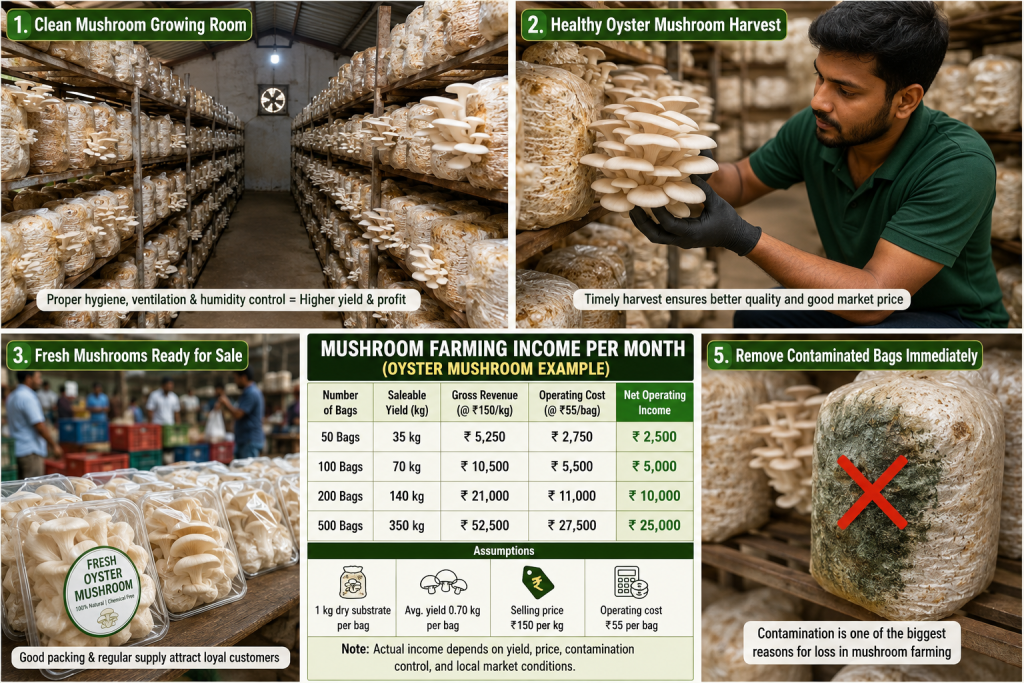
Mushroom farming is often promoted as a small business that can generate high income from limited space. While it can provide a useful part-time or full-time income, actual profit depends on mushroom variety, yield, contamination control, selling price and access to regular buyers.
A beginner should not calculate mushroom farming income per month using only the number of bags. The quantity of dry substrate in each bag, crop duration, saleable yield, production expenses and local market price must also be considered.
This guide provides a realistic small-scale income model for oyster mushroom cultivation in India. The calculations are illustrations rather than guaranteed returns. Farmers should replace the assumed price and expenses with figures from their own location before investing.
How Much Can You Earn From Mushroom Farming Per Month?
Under a small-scale oyster mushroom model, estimated net operating income may range from approximately ₹2,500 with 50 bags to ₹25,000 with 500 bags per batch-equivalent.
This calculation assumes:
- One kilogram of dry straw or similar substrate per bag
- An average saleable yield of 0.70 kg per bag
- An average selling price of ₹150 per kg
- An operating expense of approximately ₹55 per bag
- Staggered production that produces one complete batch-equivalent each month
- Produce is sold fresh without major unsold stock
The estimate does not include building rent, construction, permanent equipment, loan interest, depreciation, taxation or the full salary of the owner.
Estimated Mushroom Farming Income Per Month by Scale
| Number of active bags | Estimated saleable yield | Gross revenue at ₹150/kg | Estimated operating cost | Estimated net operating income |
|---|---|---|---|---|
| 50 bags | 35 kg | ₹5,250 | ₹2,750 | ₹2,500 |
| 100 bags | 70 kg | ₹10,500 | ₹5,500 | ₹5,000 |
| 200 bags | 140 kg | ₹21,000 | ₹11,000 | ₹10,000 |
| 500 bags | 350 kg | ₹52,500 | ₹27,500 | ₹25,000 |
Important calculation
The figures above use the following formula:
Gross revenue = Saleable mushroom yield × Selling price
Net operating income = Gross revenue − Operating expenses
For example, a 100-bag batch producing 70 kg and selling at ₹150 per kg would generate:
- Gross revenue: 70 kg × ₹150 = ₹10,500
- Estimated operating expenses: 100 bags × ₹55 = ₹5,500
- Estimated net operating income: ₹10,500 − ₹5,500 = ₹5,000
These numbers can rise or fall significantly according to yield and selling price.
Income From 100 Mushroom Bags
Many beginners ask how much income can be earned from 100 mushroom bags.
Using the assumptions in this guide, 100 bags may produce approximately 70 kg of saleable oyster mushrooms. At ₹150 per kg, the gross revenue would be ₹10,500.
After deducting an estimated operating cost of ₹5,500, the net operating income would be approximately ₹5,000 per batch-equivalent.
However, selling price has a major effect on profit.
| Selling price | Revenue from 70 kg | Estimated operating cost | Estimated net income |
| ₹100/kg | ₹7,000 | ₹5,500 | ₹1,500 |
| ₹150/kg | ₹10,500 | ₹5,500 | ₹5,000 |
| ₹200/kg | ₹14,000 | ₹5,500 | ₹8,500 |
| ₹250/kg | ₹17,500 | ₹5,500 | ₹12,000 |
This table shows why direct retail sales can be more profitable than selling the entire harvest at a low wholesale price.
Mushroom Farming Cost Per Bag
The cost of preparing one oyster mushroom bag varies by location, input quality and production method. A small grower may need to account for the following expenses:
| Expense | Illustrative cost per bag |
| Dry straw or agricultural substrate | ₹8–₹12 |
| Mushroom spawn | ₹15–₹22 |
| Polythene bag, thread and related materials | ₹3–₹6 |
| Pasteurisation fuel or hot water | ₹4–₹7 |
| Cleaning and disinfecting materials | ₹2–₹4 |
| Water and electricity | ₹2–₹5 |
| Labour and handling | ₹6–₹10 |
| Packing and local marketing | ₹5–₹10 |
| Illustrative total | ₹45–₹76 |
The income table in this guide uses an average operating cost of ₹55 per bag. Growers who purchase materials in bulk or use their own agricultural residue may have lower costs. Expenses may be higher where spawn, fuel, labour or transportation is expensive.
Factors That Determine Mushroom Farming Profit
1. Saleable yield per bag
The number of bags alone does not determine income. A farmer must record the quantity of fresh mushrooms harvested from every bag.
Poor-quality spawn, unsuitable substrate moisture, weak ventilation, high temperature and contamination can reduce production. Farmers should calculate yield only from mushrooms that are healthy and suitable for sale.
2. Local selling price
Mushroom prices differ between cities, towns and villages. Wholesale traders generally offer lower prices because they purchase larger quantities and handle distribution.
Direct sales to households, supermarkets, vegetable stores, hotels and restaurants may provide a better price. However, direct marketing requires grading, packing, delivery and customer management.
3. Contamination losses
Contamination is one of the biggest risks in mushroom cultivation. A few infected bags can spread mould and reduce the saleable harvest.
Substrate pasteurisation, clean hands, sanitised tools, good-quality spawn and immediate removal of contaminated bags are essential for protecting mushroom farming profit.
4. Temperature and humidity management
Different mushroom varieties require different growing conditions. Choosing a mushroom that matches the local season can reduce electricity and climate-control expenses.
A variety that performs well naturally in the local temperature is usually safer for a beginner than a variety requiring expensive cooling.
5. Continuous market demand
Fresh mushrooms have a limited shelf life. Producing a large harvest without confirmed buyers can lead to distress selling or wastage.
The best production plan starts with the market. Farmers should identify potential customers before preparing a large number of bags.
6. Crop scheduling
Preparing every bag on the same day can result in a large harvest arriving at once. That may create marketing difficulties.
Staggered production means preparing smaller batches at regular intervals. For example, a farmer planning 100 active bags could prepare 20 to 25 bags every week instead of preparing all 100 bags on one day.
This can create a more regular harvest and steadier monthly cash flow.
Best Mushroom Varieties for Small-Scale Farming
Oyster mushrooms
Oyster mushrooms are commonly selected by beginners because they can be grown on agricultural materials such as paddy straw and wheat straw.
They are suitable for small-scale production, but growers must select a species or strain appropriate for their local temperature. Good hygiene and ventilation remain essential.
Milky mushrooms
Milky mushrooms are better adapted to relatively warm conditions and may be suitable for growers in warmer parts of India.
They require proper bed preparation, casing and environmental management. Farmers should obtain hands-on training before beginning commercial production.
Paddy straw mushrooms
Paddy straw mushrooms are associated with warm and humid conditions. They have a comparatively short production cycle but require careful timing and rapid marketing after harvest.
Button mushrooms
Button mushrooms have strong consumer recognition, particularly in cities and organised retail markets. However, commercial button mushroom cultivation generally requires compost preparation and controlled environmental conditions.
Because cooling and infrastructure expenses can be high, button mushroom farming may not be the easiest starting option for a low-budget beginner.
Space Required for Mushroom Cultivation
Mushrooms can produce income from a relatively small floor area because growing bags can be arranged vertically on racks. Nevertheless, the growing room must not be treated like an ordinary storage cupboard.
A suitable mushroom-growing space should have:
- A washable floor and walls
- Protection from insects and direct sunlight
- Adequate fresh-air exchange
- Arrangements for humidity management
- Clean water
- Separate space for substrate preparation
- A clean area for spawning
- A designated location for removing contaminated bags
- Proper drainage
- Space for harvesting, grading and packing
The exact number of bags that can be accommodated depends on rack design, spacing, room height, airflow and the production system.
Overcrowding bags to increase capacity can restrict ventilation and increase disease or contamination risk.

How to Start With 50 Mushroom Bags
A 50-bag pilot is a practical way for beginners to learn the process without taking a large financial risk.
Step 1: Obtain practical training
Learn substrate preparation, pasteurisation, spawning, incubation, fruiting management, harvesting and contamination identification from a recognised agriculture university, Krishi Vigyan Kendra, horticulture department or experienced mushroom trainer.
Step 2: Study the local market
Contact potential buyers before starting production. Ask about:
- Preferred mushroom variety
- Normal purchase quantity
- Acceptable size and quality
- Wholesale and retail prices
- Packing requirements
- Delivery schedule
- Payment terms
Step 3: Prepare a clean growing room
Clean and disinfect the room before bringing in mushroom bags. Repair water leakage, provide ventilation and prevent flies and rodents from entering.
Step 4: Purchase reliable spawn
Spawn quality directly affects colonisation and yield. Purchase fresh, properly labelled spawn from a dependable laboratory or authorised source.
Avoid old, discoloured or poorly stored spawn.
Step 5: Maintain production records
Record the following information for every batch:
- Date of bag preparation
- Spawn source and batch number
- Substrate weight
- Number of contaminated bags
- First harvest date
- Total harvest weight
- Selling price
- Production expenses
- Unsold quantity
- Net income
Step 6: Complete at least two cycles
Do not expand immediately after the first successful harvest. Complete at least two or three cycles and compare yield, contamination and sales performance.
Scale up only after production and marketing become consistent.
How to Increase Mushroom Farming Income
Sell through more than one channel
Depending entirely on one trader can be risky. Develop a mix of customers, such as:
- Local households
- Apartment communities
- Vegetable stores
- Supermarkets
- Hotels and restaurants
- Caterers
- Weekly farmers’ markets
- Online neighbourhood groups
Improve presentation
Clean, uniform and well-packed mushrooms can receive a better price than loose or damaged produce.
Use food-grade packaging and display harvest or packing dates where appropriate. Avoid making unsupported health or medicinal claims on the label.
Supply regularly
Restaurants and retailers generally value consistency. A farmer who supplies a smaller quantity regularly may build a better business than one who delivers a large quantity only occasionally.
Reduce unsold stock
Harvest according to confirmed orders whenever possible. Maintain communication with buyers and avoid producing large quantities based only on an expected market.
Explore value addition carefully
Fresh mushrooms may be converted into dried mushrooms or other processed products to extend shelf life. However, food processing, labelling, hygiene and licensing requirements must be checked before commercial sale.
Value-added products should be started only after studying processing costs and market demand.
Common Reasons Mushroom Farmers Lose Money
Starting too large
Beginners sometimes prepare hundreds of bags before learning contamination control or confirming buyers. A smaller pilot reduces the cost of early mistakes.
Believing guaranteed-income claims
Mushroom farming does not provide a guaranteed monthly salary. Yield and price can change, and biological production always carries risk.
Ignoring hidden costs
Transport, damaged packaging, rejected produce, water, electricity, cleaning materials, phone expenses and unpaid family labour should be included when calculating true profit.
Using poor-quality spawn
Cheap or improperly stored spawn may result in slow growth, contamination and low yield.
Producing without buyers
Fresh mushrooms must be sold quickly. Market planning is as important as production knowledge.
Mixing gross income with net profit
Sales revenue is not the same as profit. Farmers must deduct all operating expenses and fixed costs before deciding whether the business is financially viable.
Sample Monthly Record for 100 Bags
| Particular | Amount |
| Number of bags | 100 |
| Saleable yield | 70 kg |
| Average selling price | ₹150/kg |
| Gross revenue | ₹10,500 |
| Straw, spawn and bag materials | ₹3,500 |
| Pasteurisation, cleaning, water and electricity | ₹700 |
| Labour and handling | ₹600 |
| Packing, delivery and marketing | ₹700 |
| Total operating cost | ₹5,500 |
| Estimated net operating income | ₹5,000 |
This example excludes rent, permanent equipment, depreciation, loan interest and taxes.
Is Mushroom Farming Profitable in India?
Mushroom farming can be profitable when the grower achieves consistent yield, maintains hygiene, controls contamination and sells the crop at a suitable price.
Profitability becomes weak when:
- Yield per bag is low
- Contamination is high
- The entire harvest is sold at a low wholesale price
- Mushrooms remain unsold
- Cooling or electricity costs are excessive
- Permanent infrastructure is underused
- Loan repayments are too high
A farmer should therefore calculate profit using local figures rather than copying income claims from videos or social-media posts.
Frequently Asked Questions
How much can I earn from 100 mushroom bags?
Under the illustrative assumptions in this guide, 100 oyster mushroom bags may generate approximately ₹10,500 in gross revenue and ₹5,000 in net operating income per batch-equivalent.
Actual income depends on yield, selling price, contamination, expenses and unsold produce.
How much mushroom can one bag produce?
Yield varies according to the mushroom variety, dry-substrate quantity, spawn quality and growing conditions.
The calculation in this article assumes an average saleable yield of 0.70 kg from a bag containing approximately one kilogram of dry substrate. This is a planning assumption, not a guaranteed yield.
Can mushroom farming generate ₹50,000 per month?
It may be possible at a larger scale with strong yields and good direct-market prices. However, ₹50,000 should not be treated as a guaranteed income.
The farmer would need to calculate the required saleable quantity, production capacity, selling price, labour, infrastructure and market demand.
For example, earning ₹50,000 in net operating income at an estimated margin of ₹50 per bag would require approximately 1,000 successfully producing bag-equivalents per month. Fixed expenses would further affect the final profit.
Which mushroom is best for beginners?
Oyster mushrooms are commonly considered a practical option for beginners because they can be cultivated on agricultural substrates and are suitable for small-scale systems.
The grower must still choose a strain suited to the local season and obtain proper training.
How much space is required for 100 mushroom bags?
The required floor area depends on rack size, number of tiers, spacing, ventilation and room layout. Bags should not be crowded merely to fit a small room.
The space must also include access for inspection, harvesting, cleaning and removing contaminated bags.
Is mushroom farming possible at home?
Small-scale mushroom cultivation may be possible in a separate, clean and manageable area. It should not interfere with household hygiene or use a room that cannot be ventilated and cleaned properly.
A dedicated growing area is preferable.
What is the biggest risk in mushroom farming?
Contamination and lack of buyers are two of the biggest risks. Contamination reduces yield, while weak marketing can leave a grower with fresh produce that cannot be sold in time.
Does mushroom farming provide income every month?
Monthly income is possible only when batches are staggered and buyers are available continuously. A single batch normally produces income during its harvest period rather than generating an equal amount every calendar month.
Conclusion
Mushroom farming income per month depends on more than the number of bags. A realistic calculation must include substrate quantity, saleable yield, market price, contamination, operating expenses and fixed costs.
Using the illustrative model in this guide, 100 oyster mushroom bags may provide approximately ₹5,000 in net operating income per batch-equivalent. Better direct-market prices can increase the margin, while low yields, contamination or unsold mushrooms can reduce or eliminate profit.
Beginners should start with approximately 50 bags, complete at least two production cycles, maintain detailed records and secure regular buyers before expanding.
Mushroom farming can become a viable small enterprise, but success comes from disciplined production and marketing—not guaranteed-income promises.