
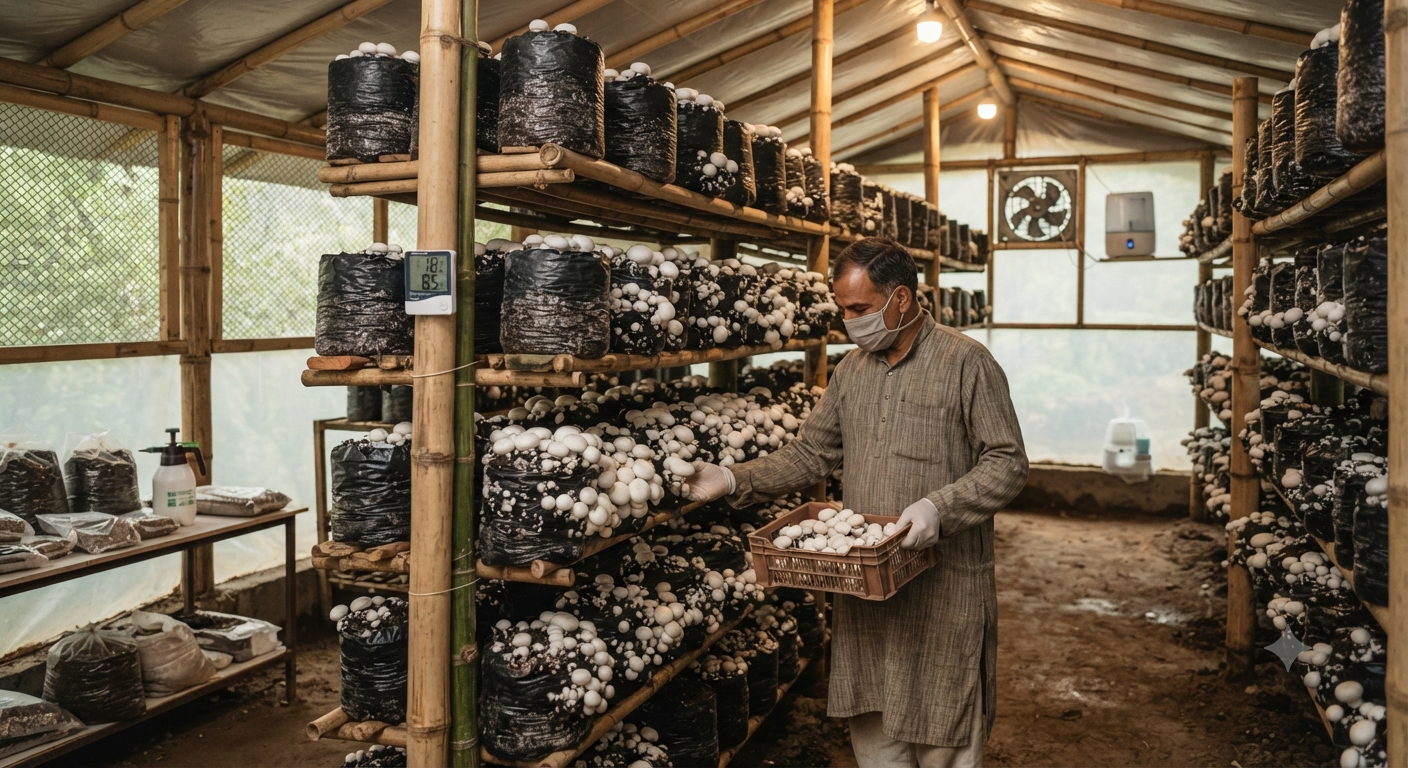
Mushroom farming is becoming an attractive small-scale agricultural business because it requires relatively little land and can be carried out in a controlled indoor environment. Unlike conventional field crops, mushrooms can be cultivated vertically using grow bags, allowing farmers and entrepreneurs to produce a marketable crop even when agricultural land is limited.
However, mushroom farming should not be viewed as a get-rich-quick business. The first few production cycles can involve contamination, poor environmental control, inconsistent yields and marketing challenges. With proper training, hygiene, crop planning and reliable buyers, a small mushroom unit can develop into a steady source of supplementary or full-time income.
This complete mushroom farming guide explains the expected income at different scales, startup costs, suitable mushroom varieties, production planning, marketing strategies, major risks and practical ways to build a profitable mushroom farming business.
Table of Contents
- What Is Mushroom Farming?
- Is Mushroom Farming Profitable in India?
- Mushroom Farming Income by Number of Bags
- How Much Space Is Required for Mushroom Farming?
- Best Mushroom Varieties for Beginners
- Oyster Mushroom Farming
- Milky Mushroom Farming
- Button Mushroom Farming
- Seasonal Mushroom Farming Strategy
- Mushroom Farming Startup Cost
- Monthly Mushroom Farming Expenses
- Mushroom Farming Yield and Profit Calculation
- How to Increase Mushroom Farming Income
- Stagger Your Production Cycles
- Reduce Climate-Control Costs
- Direct-to-Consumer Mushroom Marketing
- Mushroom Harvesting and Post-Harvest Management
- Major Risks in Mushroom Farming
- Contamination: The Biggest Challenge
- Importance of Proper Pasteurization
- Why Beginners Should Start Small
- How to Scale a Mushroom Farming Business
- Mushroom Farming Business Plan
- Frequently Asked Questions
- Conclusion
1. What Is Mushroom Farming?
Mushroom farming is the controlled cultivation of edible fungi using agricultural residues or other suitable growing materials. Instead of requiring large areas of farmland, mushrooms can be produced inside rooms, sheds or other suitable protected structures.
One of the biggest advantages is space efficiency. Mushrooms grow vertically, allowing growers to place multiple bags or growing units within a relatively small area. According to the source material, a 10 × 12-foot room can accommodate approximately 150–200 grow bags under suitable arrangements.
This makes mushroom cultivation particularly interesting for:
- Small farmers
- Rural entrepreneurs
- Women-led businesses
- Young agricultural entrepreneurs
- People with unused rooms or sheds
- Farmers looking for an additional income source
But the business requires daily attention to hygiene, moisture, temperature, ventilation, harvesting and sales.
2. Is Mushroom Farming Profitable in India?
Yes, mushroom farming can be profitable, but profitability depends on several factors rather than simply the number of bags cultivated.
The major factors include:
- Mushroom variety
- Local climate
- Quality of spawn
- Substrate cost
- Contamination rate
- Yield per bag
- Selling price
- Labour cost
- Electricity consumption
- Transportation
- Availability of buyers
- Harvest timing
- Production management
The source estimates that experienced growers operating small units can generate approximately ₹15,000–₹30,000 or more in monthly income depending on scale and local market conditions. However, these figures should be treated as practical estimates rather than guaranteed returns.
Beginners should also expect lower returns during the first few production cycles because they are still learning substrate preparation, pasteurization, environmental management and contamination control.
3. Mushroom Farming Income by Number of Bags
The number of production bags is one of the simplest ways to understand the potential scale of a mushroom business.
| Mushroom Bags | Estimated Monthly Net Income | Approx. Space | Suitable For |
|---|---|---|---|
| 50 bags | ₹6,000–₹9,000 | 30–40 sq ft | Beginners |
| 100 bags | ₹12,000–₹18,000 | 60–80 sq ft | Part-time business |
| 200 bags | ₹22,000–₹33,000 | Around 120 sq ft | Home-based business |
| 500 bags | ₹50,000–₹80,000 | 300+ sq ft | Small commercial unit |
These figures are estimates reported in the supplied source and assume costs such as raw materials, spawn, transportation and electricity have been accounted for.
Actual income can vary considerably between locations and production cycles.
For example, the source describes a South Indian grower operating around 120 bags as generating approximately ₹18,500 in monthly net income under the stated conditions.
The important lesson is that bag count alone does not determine profit. A grower with better contamination control and direct customers can potentially earn more from a smaller production unit than a grower selling large volumes through low-margin wholesale channels.
4. How Much Space Is Required for Mushroom Farming?
Mushroom cultivation is attractive partly because it does not require extensive agricultural land.
A small operation can begin with a spare room, unused shed or other appropriately prepared space.
The source gives the following approximate space requirements:
- 50 bags: 30–40 sq ft
- 100 bags: 60–80 sq ft
- 200 bags: approximately 120 sq ft
- 500 bags: 300+ sq ft
The exact capacity will depend on the type of mushroom, bag size, shelving arrangement, ventilation and working space.
The growing room should allow sufficient air circulation and make it possible for the farmer to inspect bags, identify contamination and harvest mushrooms without damaging the crop.
5. Best Mushroom Varieties for Beginners
Choosing the right variety is one of the most important decisions before starting a mushroom business.
The three varieties discussed in the supplied material are:
Oyster Mushroom
Oyster mushrooms are presented as a suitable starter variety because of their resilience and relatively manageable production requirements.
Milky Mushroom
Milky mushrooms are particularly interesting for warmer regions because they can tolerate conditions in which oyster mushrooms may struggle. The source notes local selling prices of approximately ₹80–₹100 per kg under its stated market conditions.
Button Mushroom
Button mushrooms are popular but considerably more demanding from a climate-control perspective. The source indicates that they require cooler temperatures and casing, making them challenging in hot areas without appropriate climate-control infrastructure.
Therefore, beginners should not automatically select the most popular mushroom. The better choice is the variety that matches the local climate, infrastructure, technical skill and market demand.
6. Oyster Mushroom Farming
Oyster mushroom cultivation is often considered a practical entry point for beginners.
Grey oyster mushrooms are described in the supplied material as resilient to temperature fluctuations and comparatively resistant to contamination.
Under the source’s stated conditions, a 200-bag oyster mushroom unit could potentially generate approximately ₹20,000–₹35,000 per month.
One advantage of oyster mushrooms is their suitability for relatively small indoor units. Farmers can experiment with a limited number of bags before investing in a larger production facility.
The key priorities are:
- Good-quality spawn
- Clean substrate
- Correct pasteurization
- Appropriate moisture
- Adequate ventilation
- Regular monitoring
- Fast harvesting
- Reliable customers
7. Milky Mushroom Farming
Milky mushrooms can be particularly useful for growers operating in warmer regions.
According to the supplied source, milky mushrooms can perform better during the hot South Indian summer period when oyster mushrooms may face environmental difficulties. The source estimates local prices of approximately ₹80–₹100 per kg under its cited conditions.
The exact economics, however, depend on the local market.
Before starting commercial production, growers should check:
- Local wholesale prices
- Retail prices
- Hotel and restaurant demand
- Local consumer preferences
- Availability of spawn
- Seasonal production conditions
A higher selling price does not automatically mean higher profit if production costs or crop losses are also higher.
8. Button Mushroom Farming
Button mushrooms are highly popular in the market but generally require greater environmental control.
The supplied material states that button mushrooms require cooler conditions below approximately 24°C and involve a casing process.
Casing refers to placing a suitable moist top layer over the growing medium to encourage mushroom formation.
Because temperature control is more demanding, button mushroom production can require additional infrastructure in warmer parts of India.
For a beginner with limited capital, oyster or another locally suitable variety may therefore be a more practical starting point.
9. Seasonal Mushroom Farming Strategy
One interesting strategy is to change mushroom varieties according to the season.
The supplied source proposes:
October–February: Oyster mushrooms
March–September: Milky mushrooms
This type of seasonal rotation can help growers maintain production throughout the year without relying entirely on expensive artificial cooling.
The exact seasonal calendar should be adapted to local temperature, humidity and market conditions.
The bigger principle is simple:
Choose the crop according to the environment instead of forcing the environment to suit the crop.
10. Mushroom Farming Startup Cost
Mushroom farming can be started at relatively small scale.
The supplied material estimates that a 50-bag setup can be started for under ₹8,000 under its stated assumptions.
The example budget includes:
| Item | Approximate Cost |
|---|---|
| Paddy straw/agricultural waste | ₹3,000 |
| Mushroom spawn | ₹2,000 |
| Growing bags and clips | ₹1,500 |
| Hand sprayer and thermometer | ₹1,500 |
| Total | ₹8,000 |
These are illustrative figures from the supplied material, not universal current market prices. Local prices for straw, spawn, equipment and labour can be different.
A commercial farmer should therefore prepare a location-specific budget before investing.
11. Monthly Mushroom Farming Expenses
After the initial setup, recurring expenses become more important.
For a 100-bag operation, the supplied source gives an example monthly budget of:
| Expense | Approximate Monthly Cost |
|---|---|
| Fresh straw/substrate | ₹4,000 |
| Fresh spawn | ₹1,200 |
| Electricity | ₹600 |
| Transportation | ₹400 |
| Total | ₹6,200 |
However, a complete commercial calculation should also consider labour, water, packaging, cleaning materials, depreciation, rent if applicable, marketing, rejected produce and unexpected crop losses.
That is why farmers should calculate net profit, not simply sales revenue.
12. Mushroom Farming Yield and Profit Calculation
A simple business formula is:
Net Profit = Total Mushroom Sales − Total Production Costs
Total sales depend on:
Quantity Sold × Selling Price per kg
For example, if a grower produces 300 kg and sells the crop at ₹60/kg:
Gross Sales = 300 × ₹60 = ₹18,000
The grower must then subtract all relevant production and marketing expenses.
This is particularly important in mushroom farming because fresh mushrooms are highly perishable. Unsold mushrooms can quickly reduce the expected profit.
The supplied source uses ₹60/kg as an example selling price for a 100-bag setup and estimates ₹12,000–₹18,000 in monthly net profit after the learning curve under its assumptions.
13. How to Increase Mushroom Farming Income
Increasing production is not the only way to increase profit.
Three particularly practical strategies from the supplied material are:
- Stagger production.
- Reduce unnecessary climate-control expenses.
- Sell directly to customers.
These strategies focus on improving the economics of the existing production system rather than simply increasing the number of bags.
14. Stagger Your Production Cycles
One of the common beginner mistakes is preparing all the bags simultaneously.
This creates a major marketing problem.
If all bags are prepared together, the grower may experience:
Several weeks with little or no harvest → followed by a sudden large harvest.
Fresh mushrooms cannot simply be stored indefinitely.
The supplied source recommends preparing smaller batches every four to five days so that harvests are distributed more evenly.
For example:
Week 1 → Batch A
Week 1 → Batch B
Week 2 → Batch C
Week 2 → Batch D
This creates a more predictable supply pattern.
It also makes customer relationships easier because hotels, restaurants and households can receive mushrooms regularly instead of receiving a large quantity once every few weeks.
15. Reduce Climate-Control Costs
Temperature management can become one of the biggest expenses in mushroom production.
But expensive technology is not always necessary for every variety.
The supplied source describes simple approaches such as:
- Wet gunny sacks
- Water-filled clay pots
- Shaded growing areas
- Natural ventilation
These techniques may help moderate environmental conditions in suitable situations.
However, these methods should not be treated as universal substitutes for proper climate control. The required temperature and humidity depend on the mushroom species and production stage.
16. Direct-to-Consumer Mushroom Marketing
Production is only half of the mushroom business.
Selling is equally important.
The source suggests reducing dependence on middlemen by developing direct relationships with:
- Local households
- Hotels
- Restaurants
- Retail shops
- Local food businesses
According to the supplied material, direct selling may allow growers to obtain around ₹70–₹72/kg compared with wholesale prices of approximately ₹58–₹60/kg under the stated example conditions.
A farmer can create a simple local customer network using:
WhatsApp → Weekly availability message → Pre-orders → Same-day harvest → Local delivery
This model can reduce unsold inventory and potentially improve margins.
17. Mushroom Harvesting and Post-Harvest Management
Mushrooms are highly perishable.
This means harvesting should be connected directly to the sales plan.
The supplied source emphasizes that growers should avoid harvesting large quantities without having buyers ready because mushrooms can quickly lose quality and weight.
A better approach is:
Identify buyers → Estimate demand → Harvest required quantity → Pack carefully → Deliver quickly
For a small business, local same-day sales can be particularly valuable.
18. Major Risks in Mushroom Farming
Like any agricultural enterprise, mushroom cultivation involves risks.
The major risks include:
Contamination
Mould and bacteria can destroy growing bags and reduce yields.
Climate Problems
Excessive heat, insufficient humidity or poor ventilation can negatively affect production.
Market Risk
Growing mushrooms without knowing where they will be sold can result in wastage.
Price Fluctuation
Local prices can change according to supply and demand.
Perishability
Fresh mushrooms have a limited shelf life compared with many dry agricultural commodities.
Lack of Technical Knowledge
Beginners may lose an entire batch because of incorrect substrate preparation or poor hygiene.
19. Contamination: The Biggest Challenge
Contamination is one of the most important risks for beginners.
The supplied source notes that new growers can experience major crop losses when they rush substrate cooling or fail to properly pasteurize the growing material.
The source also warns that contaminated equipment can spread problems throughout the growing operation.
Therefore, hygiene should be treated as a fundamental part of the business rather than an optional step.
Important principles include:
- Keep equipment clean.
- Properly prepare the substrate.
- Follow appropriate pasteurization procedures.
- Allow substrate to cool before spawning.
- Inspect bags regularly.
- Separate contaminated bags immediately.
- Avoid introducing unnecessary contaminants into the growing room.
20. Importance of Proper Pasteurization
Pasteurization is a critical part of substrate preparation for many mushroom cultivation systems.
The objective is to reduce unwanted microorganisms that can compete with mushroom mycelium.
A beginner should not rely solely on random online instructions because different mushroom species and substrates require different production procedures.
Hands-on training can help growers understand:
- Substrate preparation
- Moisture management
- Pasteurization
- Spawning
- Incubation
- Fruiting conditions
- Contamination identification
- Harvesting
The supplied material recommends attending a local two-day mushroom workshop or training program before making a major investment.
21. Why Beginners Should Start Small
Starting with 50 bags instead of immediately investing in hundreds of bags can significantly reduce financial risk.
A small pilot operation allows you to learn:
- How much substrate is required
- How much spawn is needed
- How quickly bags colonize
- How to identify contamination
- How much labour is required
- How much yield you actually obtain
- What local customers are willing to pay
The supplied source specifically recommends gradual expansion instead of moving immediately from 50 bags to 500 bags.
22. How to Scale a Mushroom Farming Business
A sensible growth model could be:
Stage 1: 50 bags
Stage 2: 100 bags
Stage 3: 200 bags
Stage 4: 300–500 bags
Instead of expanding purely based on available space, expand when three things are working:
Production + Quality + Sales
If contamination is still high, increase training rather than bag count.
If production is good but sales are weak, focus on marketing.
If sales are strong but production is insufficient, then consider expansion.
This approach protects working capital and reduces the risk of producing more mushrooms than you can sell.
23. Mushroom Farming Business Plan
A simple mushroom farming business plan should include the following:
Business Objective
Decide whether the farm will provide:
- Supplementary income
- Full-time income
- Household-level production
- Commercial production
- Hotel/restaurant supply
- Retail sales
Production Capacity
Start by deciding the number of bags.
Infrastructure
Estimate the cost of:
- Growing room
- Shelving
- Bags
- Sprayer
- Thermometer
- Ventilation
- Water supply
- Cleaning equipment
Production Cost
Calculate:
Spawn + Substrate + Bags + Labour + Electricity + Water + Packaging + Transport
Expected Revenue
Calculate:
Expected Yield × Expected Selling Price
Marketing
Identify customers before scaling.
Risk Management
Keep a contingency amount for crop losses, equipment repairs and price fluctuations.
24. Frequently Asked Questions About Mushroom Farming
Is mushroom farming profitable?
Mushroom farming can be profitable when production costs, contamination, yields and marketing are properly managed. The supplied guide estimates that small units can generate several thousand to tens of thousands of rupees in monthly net income, depending on scale and conditions.
How much can I earn from 100 mushroom bags?
The supplied estimate is approximately ₹12,000–₹18,000 in monthly net income under the stated assumptions. Actual results can vary by variety, yield, selling price, costs and crop losses.
How much can I earn from 200 mushroom bags?
The supplied estimate is approximately ₹22,000–₹33,000 per month for a 200-bag setup. These are estimates rather than guaranteed returns.
Which mushroom is best for beginners?
The supplied material identifies grey oyster mushrooms as an ideal starter variety because of their resilience and comparatively manageable production characteristics.
Which mushroom is suitable for hot climates?
Milky mushrooms are highlighted in the source as a suitable option for hot South Indian conditions where oyster mushrooms can face greater environmental challenges.
Can mushrooms be grown at home?
Yes, small-scale mushroom cultivation can be carried out in a suitable room or protected space. The supplied estimates indicate that even 50 bags can fit within a relatively small area.
How much does it cost to start mushroom farming?
The supplied example estimates a 50-bag setup at under ₹8,000, including substrate, spawn, bags and basic equipment. Local costs can vary.
What is the biggest problem in mushroom farming?
Contamination is one of the major challenges, particularly for beginners. Poor substrate preparation, inadequate pasteurization and introducing spawn before the substrate has cooled can cause serious losses.
How can I sell fresh mushrooms?
Growers can target local households, hotels, restaurants, retailers and direct consumers. Direct local sales can potentially improve margins compared with selling exclusively through middlemen.
Can mushroom farming provide year-round income?
It can potentially provide more consistent production by selecting varieties according to seasonal conditions. The supplied source suggests oyster mushrooms during cooler months and milky mushrooms during warmer months as one possible rotation strategy.
Should I start with 500 bags?
For a beginner, starting at a smaller scale is generally more practical. The supplied guide recommends gradual expansion so growers can master contamination control and develop reliable customers before making larger investments.
Do I need expensive equipment?
Not necessarily for a small operation, depending on the mushroom variety and local climate. The source describes low-cost approaches for moderating growing conditions, but environmental requirements vary by species.
Is mushroom farming better than traditional farming?
Mushroom farming is not automatically better. Its main advantage is that it can generate production from a small space. It can therefore complement traditional farming, particularly for farmers with limited land or unused indoor space.
Conclusion: Is Mushroom Farming a Good Business?
Mushroom farming can be a promising small-scale agricultural business, particularly for entrepreneurs who have limited land but access to a suitable room, reliable water, basic equipment and a nearby market.
The biggest mistake is to focus only on impressive income numbers.
Successful mushroom farming is built on four fundamentals:
Good Production + Low Contamination + Consistent Quality + Reliable Buyers
A beginner should start small, learn the production process, understand the local market and gradually increase capacity. The supplied material recommends gaining hands-on experience through a local mushroom training workshop before making a major investment.
The real opportunity is not simply growing mushrooms. It is building a repeatable production and marketing system.
Start with 50 bags.
Learn the process.
Track every cost.
Record every kilogram harvested.
Build local customers.
Reduce contamination.
Then scale.
That approach is far more realistic than chasing overnight-profit claims—and it can turn a small unused space into a practical agricultural income source. 🍄🌱
Important note: The income, cost and selling-price figures in this article are estimates derived from the supplied source material. They should not be interpreted as guaranteed 2026 market returns. Actual economics vary by mushroom species, location, season, input prices, production efficiency, labour, yield and local selling prices.