

Maize Seed Rate Calculator: A Complete Guide to Accurate Seed Planning for Maximum Yield
Published: 2025-07-03
Introduction
One of the most critical decisions a farmer makes before planting season is determining how much seed to buy. Buy too little, and you leave yield potential in the field. Buy too much, and you waste money on seed that never gets planted. For maize (corn) growers, the difference between a profitable harvest and a disappointing one often starts with a simple but powerful tool: the maize seed rate calculator.
This guide explains everything you need to know about calculating maize seed requirements — from the basic formula to advanced adjustments for germination, purity, spacing, and growing conditions. Whether you are planting one acre or one hundred, this article will help you make precise, cost-effective seed decisions.
What Is Maize Seed Rate?
Maize seed rate is the amount of seed (measured in kilograms or bags) required to plant a given field area to achieve the target plant population. It is not simply a fixed number of kilograms per acre. The correct seed rate depends on:
- Field size (acres or hectares)
- Target plant population (plants per acre)
- Seed germination percentage
- Seed purity percentage
- Thousand-kernel weight (TKW)
- Planting method and equipment
- Growing conditions (irrigated vs. rainfed)
Most farmers are familiar with the rule of thumb: 8 to 10 kg of hybrid maize seed per acre under standard conditions. But that figure assumes certified seed with 90–95% germination and 97–99% purity. If your seed quality differs — or if you are planting at different densities — the required seed rate changes significantly.

The Maize Seed Rate Formula
The standard formula used by agronomists and seed calculators is:
Adjusted Seed Rate (kg/acre) = Base Seed Rate ÷ (Germination% ÷ 100) ÷ (Purity% ÷ 100)
Breaking Down the Formula
- Base Seed Rate: The standard agronomic recommendation for your maize type and spacing (typically 8–10 kg/acre for hybrid maize).
- Germination %: The percentage of seeds that will actually sprout and produce a seedling. This is usually printed on the seed bag certificate.
- Purity %: The percentage of actual maize seed in the bag. The remainder may be inert material, weed seeds, broken kernels, or other crop material. Worked Example
Scenario: You are planting 1 acre with a base rate of 8 kg/acre, using certified hybrid seed labeled at 90% germination and 98% purity.
- Adjusted Rate = 8 ÷ (0.90 × 0.98)
- Adjusted Rate = 8 ÷ 0.882
- Adjusted Rate = 9.07 kg per acre
Even though the base rate is 8 kg, you actually need 9 kg to achieve the target plant population because 10% of the seeds will not germinate and 2% of the bag is non-seed material.
Recommended Maize Seed Rates by Type
Different maize varieties and uses require different seeding densities. Here is a quick reference:
| Maize Type | Seed Rate per Acre | Target Plants per Acre |
|---|---|---|
| Hybrid (single-cross) | 8–10 kg | 27,000–33,000 |
| Hybrid (double-cross) | 9–11 kg | 25,000–30,000 |
| High-density hybrid | 10–12 kg | 33,000–40,000 |
| Open-Pollinated (OPV) | 10–12 kg | 25,000–30,000 |
| Sweet corn | 8–10 kg | 20,000–25,000 |
| Baby corn | 20–25 kg | 80,000–100,000 |
| Fodder / Silage | 25–30 kg | 100,000+ |
How Germination Affects Seed Rate
Germination is the single most important variable in seed rate calculation. Many farmers assume all certified seed germinates at 95%, but real-world testing often shows 85–90% for stored seed, and even lower for farm-saved seed.
Germination Adjustment Table
| Germination % | Seed Rate per Acre | Extra Seed vs. 95% |
|---|---|---|
| 95% | 8.6 kg | Baseline |
| 90% | 9.1 kg | +0.5 kg |
| 85% | 9.6 kg | +1.0 kg |
| 80% | 10.2 kg | +1.6 kg |
| 75% | 10.9 kg | +2.3 kg |
| 70% | 11.7 kg | +3.1 kg |
Practical takeaway: Every 5% drop in germination adds roughly 0.5 kg per acre to your seed requirement. On a 10-acre field, that is an extra 5 kg of seed — half a bag you may not have budgeted for.


How Seed Purity Affects Seed Rate
Seed purity measures the percentage of genuine maize seed in a lot. A bag labeled 95% purity means 5% of the weight is inert material, weed seeds, broken kernels, or debris. You pay for that 5% by weight, but it produces zero plants.
Purity Impact Table
| Purity % | Actual Seed in 10 kg Bag | Waste Per Bag |
|---|---|---|
| 99% | 9.9 kg | 0.1 kg |
| 97% | 9.7 kg | 0.3 kg |
| 95% | 9.5 kg | 0.5 kg |
| 90% | 9.0 kg | 1.0 kg |
| 85% | 8.5 kg | 1.5 kg |
At 9 kg per acre across 50 acres, a 4% purity gap (95% vs. 99%) leaves you nearly 18 kg short of viable seed if you bought by total weight alone.
Real-World Example Scenarios
Example 1: Certified Hybrid, 1 Acre
- Inputs: 1 acre, base rate 8 kg, 95% germination, 99% purity
- Calculation: 8 ÷ (0.95 × 0.99) = 8.51 kg
- Result: Round up to 9 kg. One 10 kg bag covers this with a small buffer. Example 2: Stored Certified Seed, 5 Acres
- Inputs: 5 acres, base rate 8 kg, 85% germination, 97% purity
- Calculation: 8 ÷ (0.85 × 0.97) = 9.7 kg/acre × 5 = 48.5 kg
- Result: Buy 6 bags (10 kg each) for safety. Example 3: Farm-Saved Seed, 10 Acres
- Inputs: 10 acres, base rate 8 kg, 82% germination, 92% purity
- Calculation: 8 ÷ (0.82 × 0.92) = 10.6 kg/acre × 10 = 106 kg
- Result: Buy 11 bags (10 kg each). Farm-saved seed typically requires 25–30% more than certified seed. Example 4: High-Density Planting, 2 Acres
- Inputs: 2 acres, base rate 10 kg (high-density), 93% germination, 98% purity
- Calculation: 10 ÷ (0.93 × 0.98) = 10.97 kg/acre × 2 = 21.9 kg
- Result: Two 10 kg bags plus one 5 kg bag.


How Many Bags of Maize Seed per Acre?
Farmers often buy seed by the bag, not by the kilogram. Here is a practical guide:
| Field Size | Seed Required | 10 kg Bags Needed |
|---|---|---|
| 0.5 acre | ~4.5 kg | 1 bag |
| 1 acre | ~9 kg | 1 bag (certified) / 2 bags (farm-saved) |
| 2 acres | ~18 kg | 2 bags |
| 5 acres | ~45 kg | 5 bags |
| 10 acres | ~90 kg | 9–10 bags |
| 20 acres | ~180 kg | 18–19 bags |
| 1 hectare | ~22 kg | 3 bags |
How Many Seeds Are in 1 kg of Maize?
Seed weight varies by variety. A kilogram of hybrid maize contains between 2,200 and 3,500 seeds, depending on the Thousand-Kernel Weight (TKW).
| TKW (g) | Seeds per kg | Seeds in 10 kg Bag |
|---|---|---|
| 250 g | ~4,000 | ~40,000 |
| 280 g | ~3,570 | ~35,700 |
| 300 g | ~3,333 | ~33,330 |
| 320 g | ~3,125 | ~31,250 |
| 350 g | ~2,857 | ~28,570 |
Target seeds per acre: To achieve 27,000 plants at 90% germination and 98% purity, you must place approximately 30,700 seeds in the ground. At TKW 300 g, that requires roughly 9.2 kg of seed.
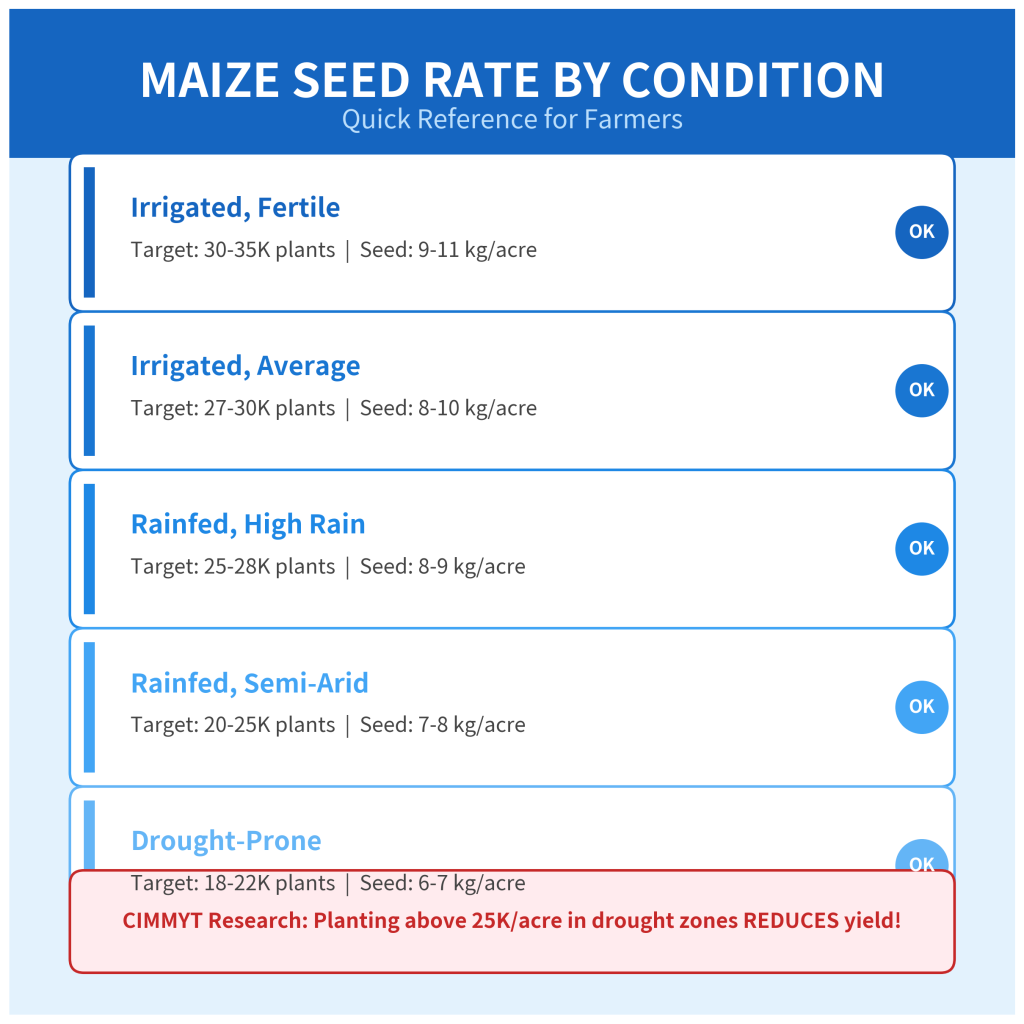
Seed Rate by Growing Condition
Rainfed vs. Irrigated
| Condition | Target Pop. per Acre | Seed Rate per Acre |
|---|---|---|
| Irrigated, fertile soil | 30,000–35,000 | 9–11 kg |
| Irrigated, average soil | 27,000–30,000 | 8–10 kg |
| Rainfed, high rainfall | 25,000–28,000 | 8–9 kg |
| Rainfed, semi-arid | 20,000–25,000 | 7–8 kg |
| Drought-prone zone | 18,000–22,000 | 6–7 kg |
Research from CIMMYT consistently shows that planting above 25,000 plants per acre in drought-prone regions reduces yield rather than increasing it, because moisture competition between plants outweighs any population benefit.
Regional Recommendations
| Region | Seed Rate per Acre | Notes |
|---|---|---|
| Tropical (high rainfall) | 8–10 kg | 60–75 × 25 cm spacing |
| Tropical (semi-arid) | 7–9 kg | Lower population, wider spacing |
| Temperate (North America) | 8–10 kg | USDA-aligned, varies by state |
| Sub-Saharan Africa | 9–12 kg | Often OPV or farm-saved |
| South/Southeast Asia | 8–10 kg | Mixed hybrid and OPV systems |
High-Density Planting
Modern single-cross hybrids bred for high-density planting can tolerate populations above 33,000 plants per acre. These varieties have narrow leaf architecture and strong stalks that resist lodging at closer spacing.
Warning: Standard varieties planted at high-density spacing produce smaller cobs and often yield less overall. High-density planting only makes sense with specifically adapted varieties, reliable irrigation, and high soil fertility.
| Density Level | Plants per Acre | Seed Rate per Acre |
|---|---|---|
| Standard | 27,000–30,000 | 8–10 kg |
| High density | 33,000–38,000 | 10–12 kg |
| Ultra-high density | 40,000+ | 12–15 kg |
Seed Rate by Plant Spacing
| Row × Plant Spacing | Plants per Acre | Base Seed Rate (kg) |
|---|---|---|
| 60 cm × 20 cm | ~33,000 | 9–10 kg |
| 60 cm × 25 cm | ~26,600 | 8–9 kg |
| 75 cm × 20 cm | ~26,600 | 8–9 kg |
| 75 cm × 25 cm | ~21,300 | 7–8 kg |
| 75 cm × 30 cm | ~17,800 | 6–7 kg |
Certified Seed vs. Farm-Saved Seed
| Seed Type | Germination | Purity | Rate Adjustment |
|---|---|---|---|
| Certified hybrid | 90–95% | 97–99% | Base rate |
| Certified OPV | 88–92% | 96–98% | +5–8% |
| Farm-saved OPV | 80–88% | 90–95% | +15–20% |
| Farm-saved hybrid | 75–85% | 88–93% | +20–30% |
Important: Farm-saved hybrid seed loses genetic performance in the second generation (hybrid vigor breakdown). Germination commonly drops to 75–85%, and purity is harder to verify without lab testing. While the seed itself is free, the extra quantity required and the yield penalty from genetic drift often make certified seed more economical.
For OPV varieties, farm-saving is agronomically sound. The FAO actively supports seed-saving programs in smallholder regions. The critical step is running a germination test before every planting season and adjusting the seed rate accordingly.
Maize Seed Cost Per Acre
Certified hybrid seed in most markets costs $3 to $10 per kg. At 9 kg per acre, that is $27 to $90 in seed cost alone.
However, the cheaper-seed calculation rarely works out:
| Seed Price per kg | Seed Needed per Acre | Seed Cost per Acre |
|---|---|---|
| $3/kg | 10.5 kg (80% germ) | ~$31.50 |
| $5/kg | 8.6 kg (95% germ) | ~$43.00 |
| $8/kg | 9 kg (90% germ) | ~$72.00 |
| $10/kg | 9 kg (90% germ) | ~$90.00 |
A $5/kg bag at 95% germination needs only 8.6 kg per acre. A $3/kg bag at 80% germination needs 10.5 kg per acre. At scale, the higher-priced, higher-quality seed often costs less per established plant.
Five Factors That Increase or Reduce Your Seed Rate
| Factor | Direction | Practical Impact |
|---|---|---|
| Low germination (<85%) | Increase | Add 10–25% more seed |
| Low purity (<97%) | Increase | Add 3–10% more seed |
| Precision planter (>95% accuracy) | Reduce | Save 5–10% vs. manual |
| Heavy or crusted soil | Increase | Add 5–10% buffer |
| High TKW seed lot | Reduce kg | Adjust by TKW, not kg alone |
When to Increase Seed Rate
- Germination test result below 85% on stored or farm-saved seed
- Heavy clay or crusted soil that reduces emergence
- Manual sowing or animal-drawn planter with less precision
- Late planting where gap-filling is not practical
- History of soil pest pressure (wireworm, cutworm)
- High weed pressure where seedling competition is elevated When to Reduce Seed Rate
- Precision planter with singulation accuracy above 95%
- Certified seed with labeled germination ≥95% and purity ≥98%
- Fully irrigated field with reliable water and high fertility
- Wide-row system designed for lower target populations
- Late-maturing, large-frame variety requiring individual space

How to Test Maize Seed Germination at Home
Before planting any stored seed, run this simple 7-to-10-day test:
- Moisten two paper towels until damp, not dripping.
- Place 50–100 seeds evenly on one towel. Fold the second towel over the top.
- Roll loosely and seal in a zip-lock bag, leaving it partially open for air circulation.
- Keep at 25–30°C for 7–10 days.
- Count germinated seeds, divide by total seeds tested, multiply by 100.
Example: 43 germinated from 50 tested = 86% germination. Enter 86 into your seed rate formula.
The FAO recommends germination testing on all stored seed lots before field planting to prevent costly stand failures.
How the Right Seed Rate Saves Money and Improves Yield
Overplanting wastes seed and creates crowding stress. Underplanting leaves yield on the field. The difference is typically 5–15% of total yield.
CIMMYT data shows that fields 10% below optimal plant population yield 5–8% less under good growing conditions. At maize grain prices of $200 per metric ton, a 5% yield gap on 10 acres costs $100–$150 in lost revenue. The seed calculation takes under 10 minutes.
Common Mistakes When Calculating Seed Rate
- Using a flat kg-per-acre figure without adjusting for germination or purity.
- Assuming certified seed means 95% germination without reading the bag label.
- Ignoring Thousand-Kernel Weight when switching between varieties.
- Measuring acreage inaccurately. A 10% acreage error creates the same error in total seed requirement.
- Buying exactly the calculated amount with no buffer for end rows or replanting.
- Treating hybrid and OPV seed as interchangeable in the calculator.
Frequently Asked Questions
Q: How much maize seed is required for 1 acre?
Most hybrid maize varieties require 8–10 kg per acre under standard conditions. Seed below 90% germination or 97% purity may need 10–12 kg.
Q: How many maize seed bags are needed for 1 acre?
For certified hybrid seed, one 10 kg bag is usually enough for one acre. For farm-saved seed, an extra bag may be needed depending on germination and purity.
Q: What is the difference between seed rate and plant population?
Seed rate is the kilograms of seed you sow per acre. Plant population is the number of living plants that actually establish. A 9 kg seed rate does not guarantee 27,000 plants if germination is 80%. The adjustment formula bridges that gap.
Q: Can seed rate be calculated without germination percentage?
Yes, but the result will likely be inaccurate. For certified seed with a labeled germination figure, you can use the default. For stored or farm-saved seed, always test first.
Q: How many maize seeds are in 1 kg?
Between 2,200 and 3,500 seeds per kg, depending on variety and TKW. A TKW of 300 g gives roughly 3,333 seeds per kg.
Q: What happens if maize is planted too densely?
Excessive population causes competition for light, water, and nutrients. Plants produce smaller, poorly filled cobs. Stalk diameter decreases, raising lodging risk. In rainfed fields, crowding under moisture stress can reduce yield more than underplanting would.
Q: Should seed rate be increased during late planting?
Yes, in most cases. Late planting shortens the growing season, leaving less time to replant gaps. Increasing seed rate by 5–10% reduces the risk of stand gaps that cannot be corrected before canopy closure.
Q: Can I reduce seed rate with a precision planter?
Yes. A precision planter with singulation accuracy above 95% reduces skips and double-planting, typically allowing a 5–10% reduction in seed rate while still hitting the target population.
Q: Does maize variety affect seed rate?
Yes. Varieties differ in TKW, plant frame size, and recommended spacing. High-density single-cross hybrids are designed for closer spacing. Late-maturing, large-frame varieties require lower populations. Always check the variety-specific cultivation guide.
Conclusion
Accurate seed rate calculation is one of the highest-return planning activities in crop establishment. It takes five minutes with a calculator and a germination test, but it prevents the two most costly mistakes in maize planting: over-seeding (wasted money and crowding stress) and under-seeding (lost yield that no fertilizer can recover mid-season).
The formula is simple, but the savings are real. Before you buy your next seed order, test your germination, check your purity, measure your field accurately, and run the numbers. Your harvest — and your wallet — will thank you.
Disclaimer: This article is for educational purposes only. Results vary by climate, soil, weather, and growing conditions. For region-specific advice, consult your local agricultural extension service or cooperative before making major planting decisions.
As a seed producer, what are the basic needs for starting to produce prebasic and basic seeds?